
Los Doyers Broke My Heart
With Opening Day upon us, I’m fighting to take back Dodgers baseball.
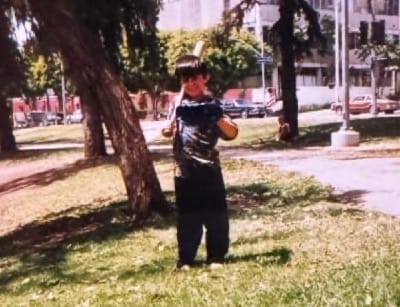
Every night, around the time the street lamps clicked on over Oxford Ave., I’d press my face against the window of our Los Angeles apartment. Between the street lamps, there were palm trees whose shade made nighttime even darker. People walking by would look like shadows. I’d stare at those shadows hoping to make out the shape of my mother as she walked down the street towards our apartment. She worked at a garment factory in East Hollywood. Immigration raids were known to target garment factories. There were kids at my elementary school who’d lost their parents in those raids.
Fear would rise every passing minute. Some nights she’d arrive by seven. Other nights it was later, if she worked overtime. Some nights I’d fall asleep by the window, waking when I heard the sound of her keys at the door.
Last year, when ICE agents descended on Los Angeles, I thought about all those kids sitting by windows. The apartment window. The school window. The car window. When you grow up like that, you look for anywhere that fear stops. I found that my fear stopped at Chavez Ravine.
Fernandomania
My brother’s dad, Juan, was the closest I ever got to having a father. Juan introduced me to the Dodgers on a beautiful afternoon in May 1989. He held my hand as we walked through the parking lot outside Dodger Stadium. Thousands of fans, all dressed in white and blue — Pantone 294, to be specific. We walked into the stadium and saw a sunset. The seats ran in bands of yellow, orange, and sky blue. The smell of cut grass mixed with the crackling aroma of Dodger Dogs cooking on the concourse. I looked around the stands. The families in the seats looked like mine.
On the mound was Fernando Valenzuela. A stocky Mexican who looked less like a professional athlete and more like someone you’d find at my family’s carne asada on Sundays. But he belonged on that field. Juan hung on every pitch from Fernando. Despite being Salvadoran, for those two-and-a-half hours we were all Mexican. When Fernando got two strikes, Juan pulled me to my feet. We chanted together, “Toro! Toro! Toro!” Fernando looked up at the sky, then delivered his signature pitch, a screwball that left the batter flailing in the wrong direction. I erupted. Juan’s hand was already up waiting for my high five. The fear at the window was gone.
The Dodgers broke baseball’s color barrier in 1947. A decade later, they bulldozed a Mexican neighborhood to build their stadium. Residents of Chavez Ravine were dragged from their homes and watched the buildings get demolished moments after. That Latino LA embraced the Dodgers anyway? As legendary broadcaster Vin Scully would say, “the impossible has happened.” In 1958, the Dodgers became the first major league team to broadcast their games in Spanish. Then Fernando showed up in the ’80s and the stadium changed.
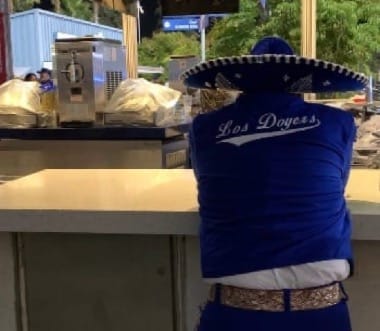
Fernandomania didn't just bring Latinos to Dodger Stadium. It made the stadium theirs. Today, four out of every ten fans in the stands are Latino. Walk around LA and you're more likely to hear the team called Los Doyers than the Dodgers. Fandom in my family and families like mine is generational. I took my godson to his first Dodger game before he even took his first step.
What Owners Can’t Own
What I’ve described so far, from Juan’s hand in mine to my toddler godson’s first game, none of that was built by an owner. No front office designed it. No corporation can replicate it — just ask an Angels fan. Dodgers fandom, the real thing, is one of the most human creations in sports. It’s a collective identity forged across cultures and generations in spite of the corporate interests that have always underpinned the game. A machine could never understand it. But the man who owns the Dodgers is betting his fortune on a world run by machines.
Before I get to what Mark Walter embraces, let me tell you what he was silent about. In the summer of 2025, federal immigration agents descended on Los Angeles. Over 2,500 people were detained in the first few weeks and over 10,000 since. Agents showed up at car washes, Home Depots, laundromats, and restaurants in Latino neighborhoods. Places my family visits every week. The city felt under siege.
Federal agents even used Dodger Stadium’s parking lot to process people they’d detained in raids. The place where fear stopped for me as a kid became a holding pen. The Dodgers sat silent for weeks. Two of Los Angeles’ 12 pro sports teams, Angel City FC and LAFC, had already released statements standing with their Latino neighbors. The Dodgers said nothing. A Los Angeles Times sportswriter called their inaction “cowardly.” Fans organized a protest outside the stadium. The Dodgers finally responded in a carefully worded announcement pledging money to local organizations.
It landed like a pat on the back when the city needed a hug. Then just last month, the Dodgers announced they would visit the White House after winning their second straight World Series. Dave Roberts, the Dodger’s manager, said the decision was about tradition and not trying to make political statements. Tradition. As if the families dragged out of Chavez Ravine would recognize the word. So I started asking a different question: not “why did the Dodgers go,” but “who benefits when they do?” And that’s how I got to Mark Walter, the owner of the Dodgers.
The Man Who Owns the Stadium
Mark Walter runs Guggenheim Partners, a $345 billion investment firm. He also runs TWG Global, a holding company he built specifically to invest in artificial intelligence. Last year, TWG announced a partnership with Palantir Technologies and Elon Musk’s xAI to deploy AI across financial services. Palantir is the company that builds the surveillance software ICE uses to find, track, and deport immigrants. In 2025, ICE paid Palantir $30 million to build ImmigrationOS, a system that aggregates passport records, tax data, driver’s licenses, and location history into a single deportation dossier.
TWG also holds a stake in Shield AI, a $5.6 billion defense company that builds autonomous drones that surveil and engage targets without a human pilot. Those drones have flown combat missions in Ukraine. They’ve been deployed by the Israeli military. And in 2016, U.S Customs and Border Patrol hired Shield AI specifically for drone surveillance at the U.S. border.
In addition, Guggenheim holds a $12 million stake in GEO Group, which runs some of the largest facilities where people picked up in raids like the ones in LA are detained.
Palantir builds the software to identify targets for ICE. Shield AI builds the drones to track targets. And GEO Group runs the camps where targets end up. Mark Walter profits from all of it while nearly half of his team’s fans live in fear of being those targets.
This is the dissonance at the center of it all. Walter is pouring his fortune into a world built on surveillance, automation, and detention. A world that reduces human beings to faceless data points that can be sorted, tracked, and contained. And yet he owns the most human thing I’ve ever been a part of. He owns the stadium where a Salvadoran man pulled a kid to his feet. Where tens of thousands of families who have nothing in common except Pantone 294 spend three hours cheering together.
Walter could never understand what it meant to watch Fernando. You can’t put that into a surveillance dossier. You can’t automate it. You can’t build a drone to replicate a bald eagle being cheered on by 50,000 fans as it escapes to freedom during a pre-game ceremony. As an aside, this actually happened at a game I attended with this newsletter’s founder.
That’s why Mark Walter said nothing when the raids came. That’s why the White House visit was easy for him. He doesn’t understand what he’s betraying because he never had it.
Chavez Ravine, One More Time
I think about Juan holding my hand in that parking lot. I think about my mother’s shape in the dark on Oxford Ave. I think about the last time my godson and I went to a game and tried to recreate a photo from our first visit.
When the City of Los Angeles came for Chavez Ravine in the 1950s, not every family left quietly. The Arechigas refused. They were carried out of their home by sheriff's deputies while the cameras rolled. The house was bulldozed the same day. They lost everything. And they never stopped saying it was theirs.
Mark Walter owns the stadium. He owns the broadcast rights and the parking lot and the luxury boxes. He does not own Los Doyers. He does not own Fernandomania. He does not own the sound of 50,000 people on their feet when the count goes to two strikes. He does not own what Juan gave me or what I gave my godson. That belongs to us. It always has.
This season, I won’t buy a ticket or watch a game until Mark Walter answers for his investments in the companies hunting his own fans. But I’m not walking away from the Dodgers. Walking away is what they want. It’s what they’ve always wanted from communities like mine. To clear out. To be quiet. To make room for whoever’s next.
I’m not clearing out. The families of Chavez Ravine didn’t. Somewhere in LA tonight, a kid is pressing their face against a window. They deserve a team whose owner won’t shake hands with the people who make them afraid. The Dodgers can still be that team. But only if the people who made it what it is fight for it. I’m fighting.
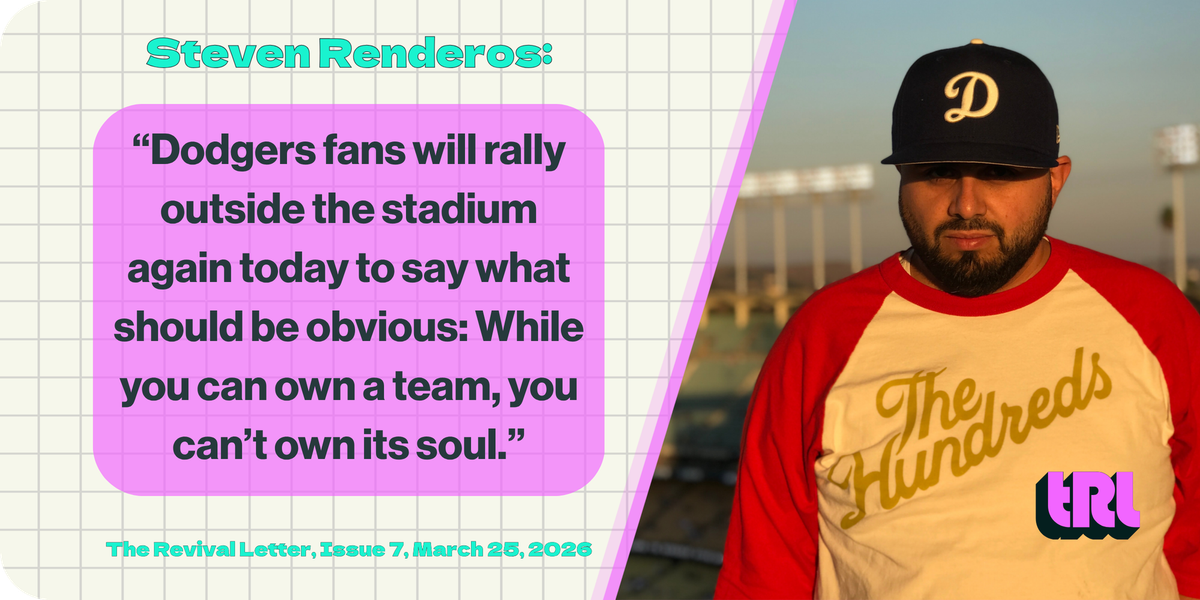
The fans who protested outside the stadium last summer are fighting, too. And as the Dodgers prepare to open up a new season tomorrow, Dodgers fans will rally outside the stadium again today to say what should be obvious: while you can own a team, you can’t own its soul.
Fernando used to look up at the sky before every pitch. I never knew what he saw up there. But I know what I saw when I looked at Fernando from the stands. A man who looked like family, winning in front of everyone. Nobody owned that moment. Not then. Not now.
Toro! Toro! Toro!
###
Steven Renderos is the Executive Director of MediaJustice.

Selected by David Dexter
The Revival Lab envisions digital spaces as extensions of the connections we build in real life, rather than as poor substitutions. We hope you see this recurring segment as us rummaging through the shelves under the TV or leafing through a CD case to hand you what we’re watching or listening to.
After a long winter, spring is finally here (knock on wood). Tomorrow is Opening Day of the baseball season, a personal holiday. The green grass, the crack of the bat, the sound of a city coming together — the ballpark is a peaceful sanctuary for me just like Dodger Stadium was for young Steven in his beautiful essay above. But Steven is right: baseball, like all sports, doesn’t exist in a vacuum, and as we saw recently in the World Baseball Classic, it is subject to, and a reflection of, our political realities. (For more about the WBC and the USA team’s military fantasy, I recommend this piece from Pinstripe Alley. Full disclosure: I am a fan of the Baltimore Orioles, but this column is a rare Yankees fan W.)
Below are some recs that show how baseball is a great canvas for painting the picture of all of America.
- Steven touched on it in his essay above, but for a deeper dive into how a Mexican superstar forever changed the Dodgers, you gotta listen to the “Fernando Who?” episode of Bring Receipts, the podcast Steven co-hosted with Brandi Collins-Dexter, The Revival Lab’s founder. For more on how the team and the city built Dodger Stadium on the demolished homes of Mexican immigrant families, you should read Eric Nusbaum’s book Stealing Home: Los Angeles, the Dodgers, and the Lives Caught in Between.
- The 2009 film Sugar tells the story of Miguel “Sugar” Santos, a young Dominican pitcher, and the challenges and culture shock he faces coming to the United States to pursue his dream. Written and directed by Anna Boden and Ryan Fleck, the story is fictional but based on the real life experiences of players who played minor league baseball in small towns across the U.S.
- The Society for American Baseball Research’s Oral History Collection includes first-person testimonials — some dating back several decades — from ballplayers, coaches, scouts, writers, and other significant baseball people. It’s a large collection that continues to grow and is worth exploring. My favorite is when former MLB commissioner Fay Vincent interviewed Negro Leagues legend and iconic baseball ambassador Buck O’Neil way back in 2000. The oral history effort goes hand-in-hand with SABR’s Baseball Biography Project, a member/volunteer driven effort that has created hundreds of thoroughly researched biographies.

This recurring section is designed to highlight some of the best critical work coming from a new generation of creators on YouTube fighting back against corruption and fascism. Left and progressive content creators, many of whom are young men, are speaking up and acting out in a popular front against the redpill manosphere, MAGA propaganda spox, and white nationalist trolls. Each issue, we’ll recommend an independent journalist or news influencer to follow to enhance your YouTube recommendations, and help signal-boost some of the best creatives who are speaking truth to power.
Good Work – Silicon Valley's New Miracle Drug
Journalist and comedian Dan Toomey wears several hats. Perhaps best known as one of the faces of the daily Morning Brew news crew on TikTok, Toomey has been building a space on YouTube with his series Good Work. Part investigative journalism, part Daily Show-esque commentary, Good Work combines progressive and satire in tight, informative, and expert-driven analysis of alarming trends in politics, finance, and health. In this video, Toomey and crew tackle the rising popularity of synthetic peptides and the emerging market for experimental compounds. Via interviews with biohackers, investigative, cardiologists, and bodybuilders, Toomey brings an informed, critical perspective to a rapidly developing topic. Unlike a lot of other creators who speak to audiences of young men, Toomey rejects bro science, hustle culture, and reactionary politics. Good Work stands out in the YouTube space for its strong but subtle progressive politics and worker-first messaging. Give Good Work a follow to sage your algorithm.
Brian Friedberg is a Project Advisor with The Revival Lab and a Senior Researcher at the Shorenstein Center on Media, Politics, and Public Policy at Harvard Kennedy School, a graduate student in Social Anthropology at Harvard University, and the coauthor of Meme Wars (2022).

- César Chávez’s Shadow — Tina Vásquez, Prism, March 23, 2026
In this powerful essay, Tina Vásquez grapples with the true legacy of César Chávez following revelations that the labor leader sexually abused young girls and women. (Prism is a nonprofit news outlet led by journalists of color. Donate to Prism.) … Recommended by David
- How Raoul Peck Became a Cinematic Griot — Lovia Gyarkye, Hammer & Hope, March 2026
This profile provides insight into an important contemporary filmmaker working at the intersection of politics and art, including the social and cultural milieu that informed his style and focus. Peck has created both documentary and narrative projects, using film as a medium to communicate and reframe political realities, including in his most recent release, Orwell: 2+2=5. In an effective documentary filmmaker’s hands, as writer Gyarkye says in this piece, “the archives are a contested site, an arena in which power can be reclaimed.” (Hammer & Hope is a magazine of Black politics and culture. Donate to Hammer & Hope.) … Recommended by Eesha
- We Found Heavy Metals and VOCs in CR's Follow-Up Braiding Hair Investigation — Shalwah Evans, Consumer Reports, February 24, 2026
This update to a prior study expands the pool of braiding hair products (not currently subject to federal regulation) that Consumer Reports researchers have tested for heavy metals and potentially dangerous chemicals. The methodology and findings outline concerns for worker and consumer safety, and a linked CR petition asks manufacturers to avoid these contaminants. (Consumer Reports is an independent nonprofit membership organization working alongside consumers for truth and transparency in the marketplace. Join Consumer Reports.) … Recommended by Eesha
- The Ellisons’ Empire: Media Consolidation, Narrative Control, and the Threat to Democracy — Coty Poynter, Nonprofit Quarterly, March 17, 2026
There are cascading impacts of the Ellison family’s acquisition of Warner Bros. Discovery and corporate media consolidation generally. Read about narrative control and how the fight ahead will be tough, but independent media should stand firm on the front lines. (Nonprofit Quarterly platforms leaders and workers in the nonprofit space. Donate to NPQ.) … Recommended by David
- How a High School Librarian in Abilene Fought Back Against Moms for Liberty — Kalyn Gensic, Texas Observer, March 11, 2026
Kalyn Gensic is a school librarian in central Texas at a time when her profession has been forced into the center of attacks on intellectual freedom. In this essay, she looks at how new state laws have made it easier for people to challenge books and how she organized colleagues and parents to fight back and won … for now. (The Texas Observer is a progressive nonprofit news outlet and print magazine covering the Lone Star State. Donate to the Texas Observer.) … Recommended by David

- Take Back Tech III
April 17-19, 2026
Atlanta, Georgia
Sponsors: MediaJustice and Mijente
Join a bunch of organizers, artists, tech workers, academics, lawyers, and more to rally and strategize our next power-building moves. The Revival Lab will be there. There's still time, but REGISTER FOR TAKE BACK TECH this week!