
Media, Power, and My Friend Brandi
The violent attacks the Department of Homeland Security has unleashed on our streets have left me reflecting on the work of my friend, Brandi Collins-Dexter, in an effort to make sense of our nation’s ongoing crisis.
I loved Brandi and had the privilege of being her friend and colleague since she first started working at MediaJustice about 15 years ago.
During our conversations, Brandi explored how power functioned in our society by examining the impact of media and tech policies and narratives on Black public spaces and Black political thought.
She wanted to understand what to do about it.
Brandi opposed media and tech consolidation and the government policies that enabled it. She knew that such consolidation resulted in the loss of Black-owned media outlets that had provided public spaces for the nourishment of Black political thought. She also lamented policies that gave greater control of our media system to corporations that trafficked in the dissemination of racist narratives.
Every day, we are reminded of the harmful and deadly impact of those same racist narratives on the lives of people in our communities.
In Minnesota, a video recorded by a right-wing influencer that claimed to expose fraud at daycare centers further fueled President Trump’s racist attacks against the state’s Somali community. Amplified by corporate media, it also provided the administration with political cover for the militarized occupation of Minneapolis-St. Paul that has since resulted in federal officers shooting three people in the city, killing two.
As the decisions of powerful media and tech owners continue to shape our political and cultural understanding of whose lives are deemed worthy and whose are not, I’m reminded of how Brandi repeatedly discussed how media and online misinformation harm Black people.
During a June 2020 congressional hearing on online disinformation, Brandi testified that the failure of social media companies to remove white supremacist hate speech from their platforms perpetuated anti-Black racism online and endangered lives. She added that “the disappearance of community-owned media, tech, and communications infrastructure” had “further compromised the ability to engage in safe and secure Black organizing” since the companies owned and controlled the data on their sites.
Brandi also authored a report published by the Shorenstein Center at Harvard University that examined how dangerous online misinformation about Covid-19 endangered Black lives. In that report, she wrote that “historical oppression, medical mistrust, and healthcare redlining were among the reasons why the Black community was vulnerable to online misinformation.” The failure of “internet platforms and media underreporting” had “left the Black community with an information vacuum” that was “being filled by dangerous false narratives online.” She also stated that “whitewashed newsrooms, blanket reporting on Black issues without layered context, and chronic underreporting of Black trauma and success have left a major gap that’s made even more clear in times of crisis.”
These factors that Brandi outlined in that 2020 report remain present in the current crisis.
A new report published by Free Press this month found that 26 of our nation’s 35 largest media and tech companies, unsurprisingly, have rolled back their commitment to diversity, equity, and inclusion during Trump’s current term. Meanwhile, it also found that several additional companies have been engaged in ”doublespeak” to obscure their wavering commitments. The impact of this abandonment can be seen in the recent purging of Black and Latinx journalists by media corporations, as their publications retreat on their coverage of race and the harms of white supremacist ideology.
This is why, in her book, Black Skinhead, Brandi argued that debates at regulatory agencies like the Federal Communications Commission and the Federal Trade Commission matter as much as fights related to criminal and economic justice. “People often say of voter suppression that if someone tries this hard to stop you from voting, that means your vote is powerful,” she wrote.“I feel that way even more about media access and ownership. For decades, media consolidation has been the silent war waged on Black communities. When people try that hard to steal your voice, we all ought to be worried.”
-------
It’s difficult to talk or write about Brandi without tearing up. I miss her.
As a friend and colleague, Brandi supported and believed in me, especially during times I contended with doubt and uncertainty. I can’t fully capture in words how much she meant to me. I know the feelings I am trying to express are also shared by many of her friends who have their own Brandi stories and know how lucky they were to have her in their lives.
I looked up to Brandi and learned so much from her. She was the most intellectually curious person I’ve known. There wasn’t a subject matter or an issue that she could not speak about, whether it was talking about politics, sports, or music.
While Brandi fought against big media and big tech, she was not content to just stop the harms these companies cause. She understood the need for ideas and solutions that redress institutional and structural racism in our media and tech systems. It’s a reason why Brandi created the Revival Lab.
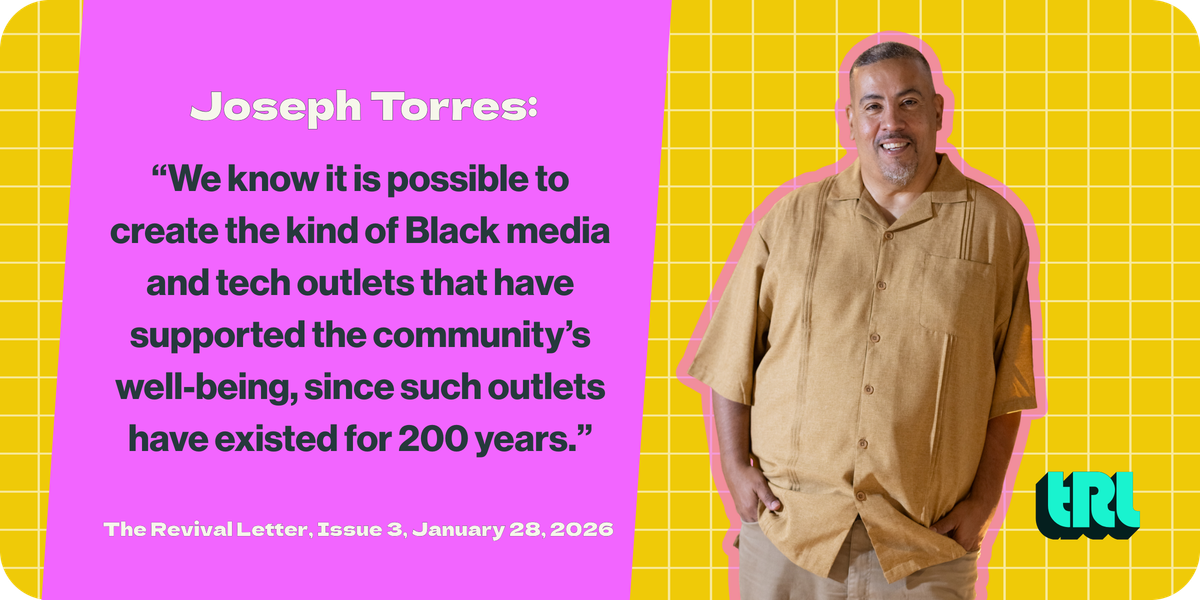
Brandi dedicated her career to ensuring that Black people could have their voices heard and tell their own stories. We know it is possible to create the kind of Black media and tech outlets that have supported the community’s well-being, since such outlets have existed for 200 years despite current and past political efforts to silence Black voices.
The launch of The Revival Lab by Brandi’s husband, David, and her co-workers, Eesha and Brian, provides us with a critical opportunity to develop the kind of analysis and investigations that support the creation of Black public spaces and Black political thought.
Brandi's research, writing, and public presentations will continue to provide a moral and spiritual blueprint that inspires the struggle for full media justice.
This is the realization of Brandi’s dream.
###
Joseph Torres is a senior advisor at Free Press, a co-founder of the Media 2070 project and a Visiting Scholar at Annenberg School of Communication at the University of Pennsylvania.
As a nonprofit project, The Revival Lab depends on the support of readers like you. Join the revival by donating today!