
Resisting Archival Silences & Dispossession: The South Side Home Movie Project
A conversation with Jacqueline Stewart
The eleven stories of the Logan Center for the Arts tower over most of the buildings surrounding it on the University of Chicago campus, and indeed most other nearby structures in the South Side neighborhood of Hyde Park. The people who walk through its doors might find themselves in any one of its rooms exploring multimedia art exhibits, catching experimental performances, grabbing a sandwich at the cafe, or shuffling to a desk for a class. Down the stairs into the basement, through a hallway in the back, past three more doors, behind several shelves within a temperature-controlled vault, lies a treasure trove of family and community history. Neatly organized piles of 8mm reels in black film cans, carefully labeled with tape and black marker — this is the South Side Home Movie Project (SSHMP).
Professor Jacqueline Stewart, a Hyde Park native, founded the SSHMP in 2005, after developing an interest in non-theatrical and “orphan” films, as well as creative reuse of personal media. “Orphan” films are those that fall outside traditional commercial distribution and archival.[1] Stewart would later ascribe a part of the pull of this category of media to her experiences of frequently watching films by Black filmmakers and about Black people in spaces outside of theaters, including at business events or churches. She saw a need to preserve the memories of everyday celebrations and domestic life on the South Side. Drawing upon her Hyde Park roots and her connection to the university as a professor in the Department of Cinema and Media Studies, Stewart started and continued to build the collection by distributing flyers and placing ads. She also held screenings and discussions to spread the word and invite families on the South Side to donate their home videos for archival and digitization.[2] In 2019, the Project joined the University of Chicago’s Arts + Public Life initiative.
The collection, which can be found online, now holds over a thousand film reels with footage ranging from the 1920s to the 1980s.[3] Donors stay engaged by attending screenings and exhibitions of the footage, as well as contributing oral histories, shared along with the films on the archive’s website.[4] Stewart is particularly passionate about facilitating conversation about and in response to the films, often alongside other curated media. She and the rest of the SSHMP team have also worked with artists like Jamila Woods and Reginald R. Robinson on multimedia creative reuse projects that draw from the videos, including the archive’s Spinning Home Movies series.
This past summer, the project celebrated its 20th anniversary with an exhibition at the Logan Center titled “The Act of Recording is an Act of Love.”[5] This statement is a nod to the importance of all types of film to collective memory. Archives, especially those housed at powerful institutions like universities, often reflect complex relationships with the people and events whose vestiges comprise their repositories. Some artifacts or narratives are entirely absent; others, through their inclusion, are decontextualized from the circumstances and contributors that made their preservation possible. To be excluded in the archive can mean erasure from the historical record; to be included can mean relinquishing ownership and control over the meaning of an artifact or a record to an unrecognizable system, either sequestered within the archive itself or as it is presented to a broader audience. Historian Achille Mbembe writes about this practice of archival that “at the same time a process of despoilment and dispossession is at work: above all, the archived document is one that has to a large extent ceased to belong to its author, in order to become the property of society at large, if only because from the moment it is archived, anyone can claim to access the content.”[6]
Stewart has sought, from the beginning of SSHMP, to maintain a bridge between the films and the people who contributed them for archival. In the interview below, Stewart discusses more about why and how the project serves as a community archive, held by the university but persistently tied to the neighborhoods and families that have contributed to it.
This interview has been edited for length and clarity. Note: The interviewer is currently a student in Stewart’s Film Ecosystems class at the University of Chicago.
When you started the archive, how did you think through the donor relationships process? I think it’s really moving and notable that you’ve created an archive that doesn’t create the usual sort of dispossession from the people who contributed the media.
Yes, exactly. Dispossession was not the goal! So when starting the project, I put myself in the place of the person who might be contemplating giving their material — their family material — to the University of Chicago, even if I was the face of it. Also, having worked on the L.A. Rebellion project, that helped me think a lot about these ideas of ownership, and provenance, and the power dynamics between people of color and white institutions.[7] So I felt it was a privilege that they were going to be sharing this material, because it’s so deeply personal. I wanted to create some frameworks and a range of options for people to share… I guess share is the word. Or give it? In some cases, people want to just get it out of the house! But in other cases, they want to be able to know that their material is going to be used by students and scholars. And so I wanted them to stay connected to it as best as possible.
We’ve seen how artists like Jamila Woods have engaged with the collection and used the videos in performances. Are there processes that you go through when someone asks to interact with the material, in terms of reaching out to the families, letting them know, or checking with them? Or is it more like they trust you to handle that unless they ask for the material back?
Yes, so that’s part of the agreement that we make with each family. And there’s a range. Some people want to [actively] give their approval no matter what the use is. Other families are just, like, “Go ahead!” Some families will say, well, if it’s for a presentation you’re doing about the project or it’s being used for educational purposes, fine, but if it’s for a commercial entity, like a documentary filmmaker or something, then they want to know what that project is. So we really just try to lay those out.
And that keeps evolving, too. Because at first, we were really policing: no, we’re not going to do this kind of commercial [use]. We tried to pre-vet that stuff. But then as the collection grew, and we were getting many different types of inquiries about it, we realized we just had to be more nuanced in how we think about this. And I guess there are probably still some types of projects I’d be, like, absolutely not. No. But commercial [use] in itself is not necessarily a terrible thing. So yeah, it really varies. We put that in the conversations right up front when we’re coming up with the gift or deposit agreement.
When these artists or collaborators come to work with you on it, do they watch the digitized versions? Or do they watch on a film projector?
Great question. So one of our graduate students, Avery LaFlamme, has been the creative producer for a number of our Spinning Home Movies projects, maybe all of them. He’s the one who has access to all the material, he knows the archive really well, and he interfaces with the artists and really talks to them about what kinds of themes they’re interested in, what’s the form that this is going to take. And then, there’s a back and forth where they’ll watch a bunch of stuff, initially just from our website. I don’t know if anyone has asked, can you pull out the original, or I want to see this projected, to get a sense of if it has the right flavor. Because we started this during COVID, it was a way of doing online programming.
So then, no, people weren’t looking at originals. I wish they would, now that you’re saying that! That could bring out a different set of questions. But for the most part – and this is not an excuse – this is low-res material. We can now scan at 4K, which is higher resolution than the actual film is. And it’s not like that there’s some weird doctoring on the images [compared to the originals]. But if you’re interested in the sound of the projector, or something about the way the light plays in the room in which you’re watching the stuff! It’s only been for the recent episodes that we’ve done live presentations, so that kind of request might come more now.
I know this is a very personal project for you because you grew up here on the South Side of Chicago. I’m curious if, by working on this project, you strengthened or cultivated a different understanding of your own experiences growing up here?
I used to be really obsessed with looking at photo albums that my grandmother had. And we would almost look at these like we were watching a movie over and over again. Like, tell me who is this? Who is that? We’d recognize some people, then find out that another person was somebody she was dating back then or whatever. I take away from that experience what it was like to see my mom, my aunt, and my cousins, when they were younger than [when] I knew them.
So to me, looking at these films — because a lot of them are from the ’60s and I was born in 1970 — it’s like I’m seeing locations that I know, but there’s just a little bit of, “oh, that used to look like that.” Something I thought I knew has this almost defamiliarizing effect. I’m getting this insight into how I plot into a longer history in a different way. I guess I knew that in the abstract, but looking at these films, just like looking at the photo albums back then, I realize it’s helping me to say: Here’s the trajectory of time, and then this is where I land, here. It gives a richness to what came before, that goes beyond storytelling or even the still pictures I used to look at. So that’s really interesting to me.
You’ve worked in these incredible places — you’ve led the Academy Museum of Motion Pictures and you’ve been an educator in all these capacities. In thinking through what constitutes equitable media or equitable access, it seems like access specifically to your community’s history, or your neighborhood’s history, would play a big part. I’m curious, how do you feel your work on this project, or this project generally, fits into your understanding of what equitable media access would look like for your community, or for yourself?
Thank you for this question, because it’s so important. You get so into the work itself sometimes that it’s hard to step back out of it. So, putting everything online, to me, is one step. But then, how do you make sure that people know that it’s there? Because even the families themselves sometimes will ask, “Well, how can I show this?” I’m like, it’s all on the website! You know this already! Or even when I used to do programming at Black Cinema House, people would come in sometimes and be like, “How come I didn’t know this was here?” So, we can always do a better job of getting the word out, I guess? You might think, oh, I did this screening and nobody knew, that’s their fault, I tried. But no, there’s always more to do, even when you’ve done all this work. It’s an ongoing effort — it’s not enough to say it’s all online and that’s how I’m providing access to everybody. That’s just one step and then there’s a whole lot of work that has to come after that — building of trust and good faith, so people tell other people in their networks about it, and maybe they check it out. So there’s that.
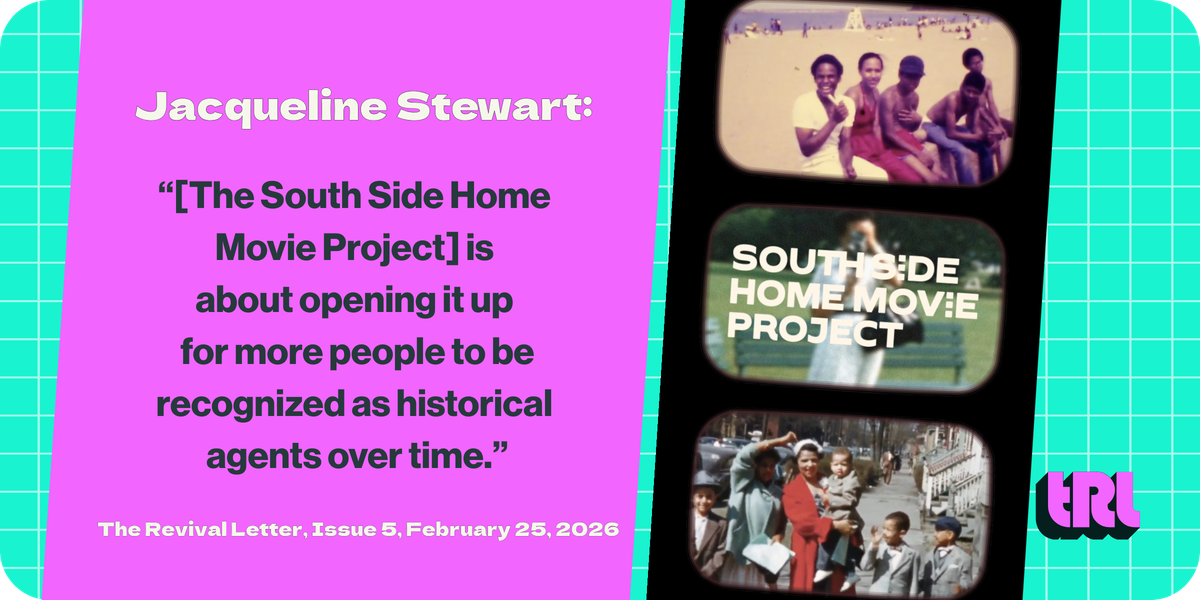
And then for people to know that there’s a space to share their stories. That’s also a really important part of equitable access and equitable media practice. Because we’re all making media, and there are so many different ways to think about these communities and networks of media production. There is real everyday media that we don’t think is that important. My goodness, if somebody could look at the stuff on your phone a hundred years from now — some of it, not all of it — what it would share about how we live and what we believe would just be incredible! So to me, it’s also about opening it up for more people to be recognized as historical agents over time.
That’s a lovely response. If you want to share, do you have just one memory of sharing the archive or one of the conversations you’ve framed around it that you feel either captures the essence of this project or even just made you feel really good about your work on it?
I think when we did our exhibition at the Logan Center, and every day we were focusing in one room of the gallery, on one family’s films. I’d see people who just came to see the exhibition, they’re walking around, and they come into this room, and people are literally recognizing each other and talking about “oh, and grandma did this,” and “auntie did that,” and “remember that dress?” It even happened with my cousins who were there, because it turned out my family had films. To me, that was it — connecting people directly to the practice of making the films and not just the objects themselves. And giving them the opportunity to talk to each other about these things. I will always treasure that.
###
Jacqueline Stewart is a professor in the Department of Cinema and Media Studies at the University of Chicago, the founder of the South Side Home Movie Project, and the host of “Silent Sunday Nights” on Turner Classic Movies (TCM).
Eesha Ramanujam is a Project Advisor at the Revival Lab and a media and tech accountability researcher, currently completing a Masters in Social Sciences at the University of Chicago.
Selected sources & additional reading:
[1] National Film Preservation Foundation. “Why Preserve Film?” https://www.filmpreservation.org/preservation-basics/why-preserve-film.
[2] Pharo, Zoe. “South Side Home Movie Project celebrates 20 years.” Hyde Park Herald, July 28, 2025. https://www.hpherald.com/arts_and_entertainment/south-side-home-movie-project-celebrates-20-years/article_296aa6ba-1476-4a78-af40-b92d80d44756.html.
[3] South Side Home Movie Archive. “The Archive.” https://sshmp.uchicago.edu/archive.
[4] South Side Home Movie Project. “Home Movie Community.” https://sshmp.uchicago.edu/home-movie-community.
[5] Logan Center for the Arts. “The Act of Recording is an Act of Love: The South Side Home Movie Project.” https://www.loganexhibitions.uchicago.edu/exhibitions/sshmp.
[6] Mbembe, Achille. “The Power of the Archive and Its Limits.” In Refiguring the Archive, edited by Carolyn Hamilton, Verne Harris, Jane Taylor, Michele Pickover, Graeme Reid, & Razia Saleh. Springer Science and Business Media, 2002.
[7] UCLA Library Film & Television Archive. “Collection: L.A. Rebellion.” https://www.cinema.ucla.edu/collections/la-rebellion.

Selected by Eesha Ramanujam
The Revival Lab envisions digital spaces as extensions of the connections we build in real life, rather than as poor substitutions. We hope you see this recurring segment as us rummaging through the shelves under the TV or leafing through a CD case to hand you what we’re watching or listening to.
This issue, enjoy these selections as a supplement to our interview with South Side Home Movie Project founder Jacqueline Stewart! Sit back and enjoy a Spinning Home Movie from the project’s Creative Re-use initiatives, editing together home videos and music curated by musician Jamila Woods for a singular, warm viewing experience. My personal favorite clip comes at about 19:05, from the Jean Patton Collection. Afterwards, enjoy Woods’s 2016 debut album HEAVN!
- From the South Side Home Movie Project: Spinning Home Movies, Episode 9 (Ode to Inner Space by Jamila Woods)
- HEAVN (album) by Jamila Woods

This recurring section is designed to highlight some of the best critical work coming from a new generation of creators on YouTube fighting back against corruption and fascism. Left and progressive content creators, many of whom are young men, are speaking up and acting out in a popular front against the redpill manosphere, MAGA propaganda spox, and white nationalist trolls. Each issue, we’ll recommend an independent journalist or news influencer to follow to enhance your YouTube recommendations, and help signal-boost some of the best creatives who are speaking truth to power.
F.D. Signifier: The Tyler Perry Video
F.D. Signifier is an Atlanta-based video essayist on the front lines of the YouTube culture wars. Equal parts fearless social philosopher and pop culture critic, F.D. has tackled a range of topics from hip hop to political economy to film, and he’s made it his mission to take on the classism, racism, misogyny, and homophobia of the online manosphere and white nationalist right. In “The Tyler Perry Video,” F.D. delivers yet another masterpiece. This 4+ hour documentary is an incredibly deep dive into the filmography, business practices, and psychology of media mogul Tyler Perry. While highly critical of the multitalented yet controversial actor/director/producer, F.D. approaches Perry’s personhood and filmography with grace and sensitivity. Either as a binge watch or viewed in shorter chunks, F.D. 's latest opus is absolutely worth your time, as is his entire catalogue of deeply-researchered and immaculately produced commentary videos. Give F.D. a follow to sage your algorithm.
Brian Friedberg is a Project Advisor with The Revival Lab and a Senior Researcher at the Shorenstein Center on Media, Politics, and Public Policy at Harvard Kennedy School, a graduate student in Social Anthropology at Harvard University, and the coauthor of Meme Wars (2022).

- How To Build Solidarity Infrastructure for the Long Haul — Adaku Utah and Deepa Iyer, Nonprofit Quarterly, February 18, 2026
This article from Iyer’s Notes from the Frontlines column, co-written with her colleague Utah, outlines frameworks for individuals and organizations to practice transformative solidarity, as well as the structures needed to resource and sustain it (including insights for funders). You may recognize Iyer’s approach to movement strategy from the Social Change Ecosystem Map. (Nonprofit Quarterly is a civic news outlet working to empower nonprofits and advance justice. Donate to Nonprofit Quarterly. The authors work for Building Movement Project, which provides research and resources for nonprofits to create a just world. Donate to Building Movement Project.) … Recommended by Eesha
- How to Become an Algorithmic Problem (Podcast) — Justin Hendrix, Tech Policy Press, February 22, 2026
In this podcast, author José Marichal talks about his upcoming book, You Must Become an Algorithmic Problem: Renegotiating the Socio-Technical Contract. He discusses how tech companies work from the belief that people are predictable, and how there are consequences when we trade unpredictability and novelty for the convenience of an algorithmically curated experience. (Tech Policy Press is a nonprofit media outlet focused on the intersection of tech and democracy. Donate to Tech Policy Press) … Recommended by David
- Philanthropy for Radicals — Claire Dunning, Dissent, February 12, 2026
The Garland Fund of 1921 to 1941 demonstrated how philanthropy could support a leftist agenda. This review of a 2025 book about the Fund wrestles with the inherent problems of relying on excessive wealth, but also acknowledges “the possibility of a more radical version of giving, and the recognition of the important role resources can play in progressive movements, is worth debating while these institutions still exist.” (Dissent is a nonprofit magazine of politics and ideas. Donate to Dissent.) … Recommended by David
- Chromosome Testing Will Take Sports Back To The Dark Ages — Michael Waters, Defector, February 16, 2026
This piece analyzes historical trends in gender policing in international sports competition, with context on how DNA “sex tests” as a practice reflect or shape public sentiment. Waters touches on right-wing anti-trans panics, institutional policies, and the weaponization of superficial scientism. (Defector is an employee-owned sports and culture website. Subscribe to Defector) … Recommended by Eesha

Take Back Tech III
April 17-19, 2026
Location: Atlanta, Georgia
Sponsors: MediaJustice and Mijente
Join a bunch of organizers, artists, tech workers, academics, lawyers, and more to rally and strategize our next power-building moves. The Revival Lab will be there. Will you?
Register for Take Back Tech (Scholarships are available.)
LitleSis Trainings
Location: Virtual
Sponsor: LittleSis (Public Accountability Initiative)
LittleSis has several trainings coming up over the next few months that help boost skills around organizing, research and power analysis. Find a training that interests you and sign up today. Registration is free.