
The Hollywood Investigators: Directing Anger and Rejecting Media Oligarchies
A few weeks before his film I Love Boosters made its way to wide release this spring, writer-director Boots Riley got involved in a back-and-forth with people on X (formerly Twitter) regarding the involvement of Megan Ellison and her company Annapurna Pictures in the production of his film. Riley has a track record of making films criticizing racism and capitalism while amplifying labor conditions and class consciousness. Those criticizing Riley saw the participation of Ellison, included in the opening credits as an executive producer, as a betrayal of Riley’s principles and the political message of the film itself. They highlighted how the Ellison family continues to exert their influence to restrict political expression, contribute resources and support for Israel’s occupation, and consolidate a right-wing chokehold on media.
Riley responded to the criticism by describing the broad capital structure of Hollywood and film distribution, including the involvement of companies with military contracts, concerning labor practices, and objectionable patterns of political giving, among other issues. He argued that participation in the filmmaking and distribution industry made engaging with such companies and people inevitable, and that no alternative yet exists to reach a broad audience by opting out of those channels.
Your generosity fuels our newsletter and research, strengthening the movement for media, tech, and information justice.
Donate now and join the revival today!
The perception that Riley had sold out, in a way, shaped discourse on social media about a number of topics — both engaging directly with him as well as about him — and industry publications asked him about the backlash. Some comments pointed out that his previous film, Sorry To Bother You, had eventually been available on Amazon Prime despite skewering an Amazon-like predatory conglomerate. Some mocking posts dismissed the political effectiveness of his film’s themes and messaging, arguing that clearly powerful capital interests did not find his work threatening. Other people piling on online accused him of stealing the idea for the movie from a short film called Rainbow Girls also made by a Bay Area filmmaker, Nana Duffuor, who had already written to debunk the rumor and to express her insight on how creators with similar political concerns and in shared cultural milieu might gravitate towards overlapping but ultimately distinct stories.
The director is not the only one whose actions have been juxtaposed with public political statements in the social media abyss. As another recent example, actress Hannah Einbinder, who has consistently uplifted the cause of Palestinian liberation as an anti-Zionist Jewish leftist, to the point of saying “free Palestine” during her Emmy acceptance speech, has faced questioning approaching the release of her upcoming film Teenage Sex and Death at Camp Miasma, directed by Jane Schoenbrun. The movie is being distributed by MUBI, which was revealed to be significantly funded by Sequoia Capital, a company with financial ties to the Israeli military. In response to this inquiry, Einbinder told Variety, “I unfortunately think there’s a lot of dark money in Hollywood. We, as artists, as individuals, don’t make those decisions. But what I can tell you is that I can and have and will continue to speak and advocate for a free Palestine. And MUBI knows that about me and they’ve been supportive of all of us.” She went on to discuss the responsibilities of leftist artists in Hollywood, and how many decision-makers in the industry were known Trump donors.
While it is not clear how often studios or distributors — especially those who get involved later on, after films are made and being shopped around — exert their influence on shaping the story, audiences are clearly being primed to examine their financial control. In other cases, studios have dropped or refused to distribute fully-completed films, either seemingly for tax benefits or possibly due to concerns about the content, choices often inferred by the public to be politically motivated.
Popular IP is no exception. Warner Bros. Discovery scrapped the almost-completed Batgirl in 2022, eliminating the $90 million movie from their docket for a tax write-off. They also decided not to release the Looney Tunes hybrid live-action/animated film Coyote vs. Acme, though they allowed the filmmaker to shop it around — the film will be released by Ketchup Entertainment later this year in partnership with Legion M, a crowdfunding platform. Some speculated online that Warner Bros. Discovery was reluctant to release a David & Goliath movie about fighting corporate greed. But many reactions to decisions like these called out the studio’s perceived incompetence and condemned what they saw as anti-art relentless pursuit of profit.
More recently, Amazon dropped the Luca Guadagnino-helmed Artificial, a nearly-finished biopic about OpenAI founder Sam Altman, shortly after the companies happened to announce a “massive partnership.” The film has now been acquired by Neon and will be released this fall. The company has already announced its intentions to mount an awards campaign for this year. But this series of events raised flags for people across the industry, indicating profound barriers for even well-known directors to make, fund, and release films criticizing corporations and their leaders.
The prevalence of “dark money” as described by Riley and Einbinder, rather than being considered a justification for abdication of responsibility, could instead be interpreted as a call to action. What would it take for movies to get made and reach their audiences without reliance on existing market structures in Hollywood? In fact, how are filmmakers already operating, with intention or by necessity, outside those parameters?
Some political documentaries have faced challenges finding distribution in the US market, including high-profile Oscar contenders, with their filmmakers blaming the inconsistency of distributors' willingness to embrace certain social issues and not others. The Academy Award-winning No Other Land, a joint effort co-directed by a Palestinian activist and an Israeli journalist which portrayed Israeli settler violence in a Palestinian village, was forced to reach theaters through an independent distribution model after it struggled to find a US partner. No Other Land co-director Basel Adra highlighted the need for broader distribution in the US, so that American audiences could be reached with the reality of what their taxpayer money was funding.
On the other hand, some films have proactively embraced this alternative to more traditional avenues, with filmmakers and subjects touring to promote their work and highlighting the political themes and relevant issues in discussions afterwards. Steal This Story, Please!, a documentary about the origin story of progressive news outlet Democracy Now! and its founder Amy Goodman, self-released earlier this year.
In many of these cases as well as in similar dialogues on social media and in article comments, several posts expressed frustration at what they characterized as political “purity tests,” which they saw as primarily weaponized against more vulnerable or underrepresented groups in Hollywood. In fact, both sides of this discussion — those who criticize the choices of artists and celebrities and those who argue for a focus on broader systems — have important overlap. The accusations push back on what audiences perceive as artists either collaborating with or allowing influence by people that represent a particularly harmful political, economic, and cultural agenda gaining traction across industries and aspects of social life. At their core, these critiques reflect a rejection of passive consumption, a determination to see the forces behind the stories and cultural artifacts that shape their lives.
Some filmmakers, critics, and watchers working within the system have pushed for a form of consumption as activism, usually as a result of intel they’ve gathered from producers about the interpretation of box office performance. Black directors, for example, have shared about meetings with executives that implied the greenlighting of their films would be dependent upon what they perceived as a similar film (i.e. also with a Black director or predominantly Black audience) achieving box office success. They have expressed disbelief at how this manufactured scarcity placed their films in baffling precarity and confusing comparisons solely because the creators and/or the assumed audiences were Black, regardless of any similarity or distinction between the stories being told. Veteran director Gina Prince-Blythewood shared in an interview that she believed the greenlighting of her film The Woman King was made possible by the profound success of Ryan Coogler’s Black Panther. Coogler’s recent film Sinners, which was a success at the Oscars and the box office, also garnered notice for the writer-director’s unusually beneficial deal giving him the ownership rights after 25 years.
Earlier this year, filmmaker Nina Lee shared online how a studio executive had refused to buy her already-filmed romantic comedy until they saw how You, Me, and Tuscany performed. A Nice Indian Boy director Roshan Sethi regularly shares data demonstrating the diversity of theater-going audiences and challenging this simplistic approach to demand, including by juxtaposing ticket revenues from Black and Latin movie-watchers with the glut of all-white casts and opportunities available to white male filmmakers.
The specter of “studio executives” and corporate influence on filmmaking, somewhat nebulous and incomprehensible to the wider audience of what they produce, looms large in the imagination of passionate film watchers, especially as stakeholders have a variety of platforms to share their critiques or align on talking points with other commenters. Studios have faced criticism for seemingly prioritizing one movie’s or one actor’s For Your Consideration (FYC) campaign over another, and not ensuring certain movies reach as many theaters as possible as a result. People have also denounced suspected use of AI in films or in their promotion, as well as, in the recent case of A24, partnership with AI companies.
Sometimes, critiques of these decisions or discourse engaging with them are dismissed outright by commenters or industry insiders because of what they seemingly fail to understand about the nature of Hollywood and media. This dismissal, though of course sometimes relevant and accurate, echoes the smug rebuttals of tech CEOs and their sycophants evading regulation and accountability on the basis of customers’ and lawmakers’ supposed lack of insight into the intricacies of their products and services. This similarity is no coincidence, especially given the increasingly intertwined nature of tech platforms and media production.
Of course, not all responses to accusations are the same; independent filmmakers bemoaning the limitations placed upon their efforts to raise funds and early-career actors that never meet the executives cashing checks from their projects are some steps away from CEOs stifling any internal dissent or external criticism of their company’s operations. But in the same vein, whether the substance of anger at or criticism of these industries and their major players is entirely accurate or not, it is important to note that these reactions are building, and could help change the structures and incentives that keep those companies relatively untouchable.
The most valuable insight from these discussions is more expansive than the moral implications of filmmakers’, actors’, or even executives’ actions or words. The people that consume media of all kinds, those most invested in picking it apart and sharing enthusiasm with their peers, are expressing distrust and frustration with the opacity of corporate decision-making and the ubiquity of corporate power. In an increasingly consolidated media landscape, such a reaction is inevitable — the people most passionate about art and storytelling, either as creators or consumers, are not always granted the power and access to shape it.
What audiences perceive is that the industries tasked with producing films, television, news broadcasts, or other forms of media are motivated by profit rather than any commitment to the content their companies produce, the workers that create it, or the audiences they supposedly serve. They see the connections between the gatekeepers greenlighting projects, maneuvering political transitions, and shepherding cultural shifts in favor of their own profits. When channeled into constructive and informed efforts, this resulting frustration across stakeholders can meaningfully contest the power of leaders in these industries, as well as their downstream social, cultural, and political influences.
As raised in critiques of the Paramount acquisition of Warner Bros. Discovery, the issue with corporate media power is not limited to whether they choose to restrict certain types of content immediately; the concern is that they have the ability to do so at all. An industry structure that erodes the leverage of workers, unionized or otherwise, and evades regulation can operate with limited accountability or even visibility, shaping public narratives alongside political and economic realities.
Media, an ever-expanding category, is at its core a type of railroad, with its billionaire leaders and founders accumulating the same unchecked wealth as the robber barons a century-and-a-half ago. It is a channel (sometimes literally) through which ideas reach the masses or can be derailed at their very inception. In many ways, there are more of these media “railroads” than ever. But the people who rely on them are not always the ones with the power to switch the tracks, or even the schedule.
Moving beyond the metaphor, it makes sense that people are concerned about how the villains they know or can’t identify are operating, and that they are attempting to play detective and make meaning out of what they perceive as overreach or censorship or anti-art attitudes. Viral posts from struggling filmmakers lay bare the challenges of getting a movie funded or produced; videos from journalists on the ground make it clear what urgent stories have been suppressed by corporate news outlets; quick Tiktok explainers and Instagram infographics break down complicated legal and antitrust concepts into a few bullet points.
A few years after a historic WGA strike, plenty of screenwriters are underemployed. Actors are evangelizing AI with rote misleading talking points. The streaming model is obliterating the economy of residuals that countless Hollywood workers have relied upon for decades. Local journalism outlets are steadily acquired by private equity and stripped for parts before going under. The average person doesn’t have to work in media to be aware of at least parts of these realities. For better or for worse, rigorous or misleading, narratives stoking curiosity and anxiety about the people behind the media and the film industry more specifically are flourishing. These moments of fear or confusion present an opportunity for organizers and advocates engaging in media justice work.
People clearly need villains and a compelling story, and the present situation offers both. Consumption of pop culture or mainstream media, while it might shape audiences in line with institutional parameters, is not inherently incompatible with rigorous power analysis. An oligarchy with the capital to influence Silicon Valley, Hollywood, and Capitol Hill is a threat whether its tendrils of influence are taut with exertion or dormant and waiting to be activated. Grounding people’s distrust with action items and additional clarity can be a strong mobilizing tactic. From demanding public arts funding to endorsing antimonopoly action to fighting the plagiarism and extraction of AI, a plethora of possibilities can channel this energy in constructive ways.
It is time to redirect the attention currently attached to corporate relationships and passion for more equitable conditions for media and art, to move away from @ing very online directors on social media with deep analytical questions or musing in Tiktok comments about the hidden meaning in actors’ exhausted red carpet answers. That attention is better channeled toward a shared understanding of power and control, as well as a shared agenda for how to contest that power so that we might — as workers, consumers, critics, participants — imagine and build a more expansive, creative, and just political economy for art, culture, and media.
###
Eesha Ramanujam is the Research Director at the Revival Lab.

- North Star Data Center Policy Toolkit — AI Now Institute, 2026
A sweeping resource for organizers and policymakers countering data center development at the state, local, and federal levels. Complete with concrete policy recommendations, guides, and trainings, it is a resource to fuel a burgeoning movement against Big Tech’s extractive presence in our communities. (The AI Now Institute produces diagnosis and policy research on AI.) … Recommended by David
- “Do You Understand Your Own Language?” — Robin D. G. Kelley, Hammer & Hope, Summer 2026
Prof. Kelley outlines how Black radicals have interpreted the Declaration of Independence and what it has communicated about liberty, democracy, and rebellion in the 250 years since its development. This piece is part of the magazine’s issue #11, assessing “250 years of white supremacy” alongside “250 years of resistance, rebellion, and refusal.” (Hammer & Hope is a magazine of Black politics and culture. Donate to Hammer & Hope.) … Recommended by Eesha
- Trump’s Crackdown on Dissent is Targeting Signal—and Zines — Jenna Ruddock, Tech Policy Press, June 26, 2026
This piece outlines the context and implications of the recent indictment by the DOJ of 15 people in Minnesota on conspiracy charges, after they participated (to varying degrees) in resistance against the escalation of federal border enforcement in the Twin Cities. The case signpoints criminalization of dissent and community organizing, particularly efforts to track or tell a fuller story about federal activities. (Tech Policy Press is a nonprofit media and community venture covering technology and democracy. Donate to Tech Policy Press.) … Recommended by Eesha
- What Broke Monticello — Bridget Gillespie, The American Prospect, July 2, 2026
A firsthand account from a former staff member at the Thomas Jefferson Foundation about the rightwing backlash to their efforts to show the legacy of slavery at Monticello. It is an interesting case study of a “coordinated escalation from tabloid journalism to policy infrastructure.” It’s also a story of what happens when institutions capitulate. (The American Prospect is a nonprofit news outlet promoting discussion on public policy from a progressive perspective. You can subscribe to them here.) … Recommended by David
- Brutal Oppression and Beautiful Humanity Exist In Every Grocery Store — Hamilton Nolan (interview with Ann Larson), How Things Work, June 10, 2026
An engaging interview with Ann Larson, whose firsthand account about working in a grocery store during the pandemic, Cleanup on Aisle Five, was published last month. Read about the grocery store as an essential workplace, and what labor came short of achieving during the pandemic. (How Things Work is a newsletter dedicated to labor, politics, and power. Subscribe to it here.) … Recommended by David

The Revival Lab envisions digital spaces as extensions of the connections we build in real life, rather than as poor substitutions. We hope you see this recurring segment as us rummaging through the shelves under the TV or leafing through a CD case to hand you what we’re watching or listening to.
Selected by Eesha
This week, check out a few compelling films we see as linked, through their content and the story of their making, to the concepts discussed in this week’s Revival Letter piece.
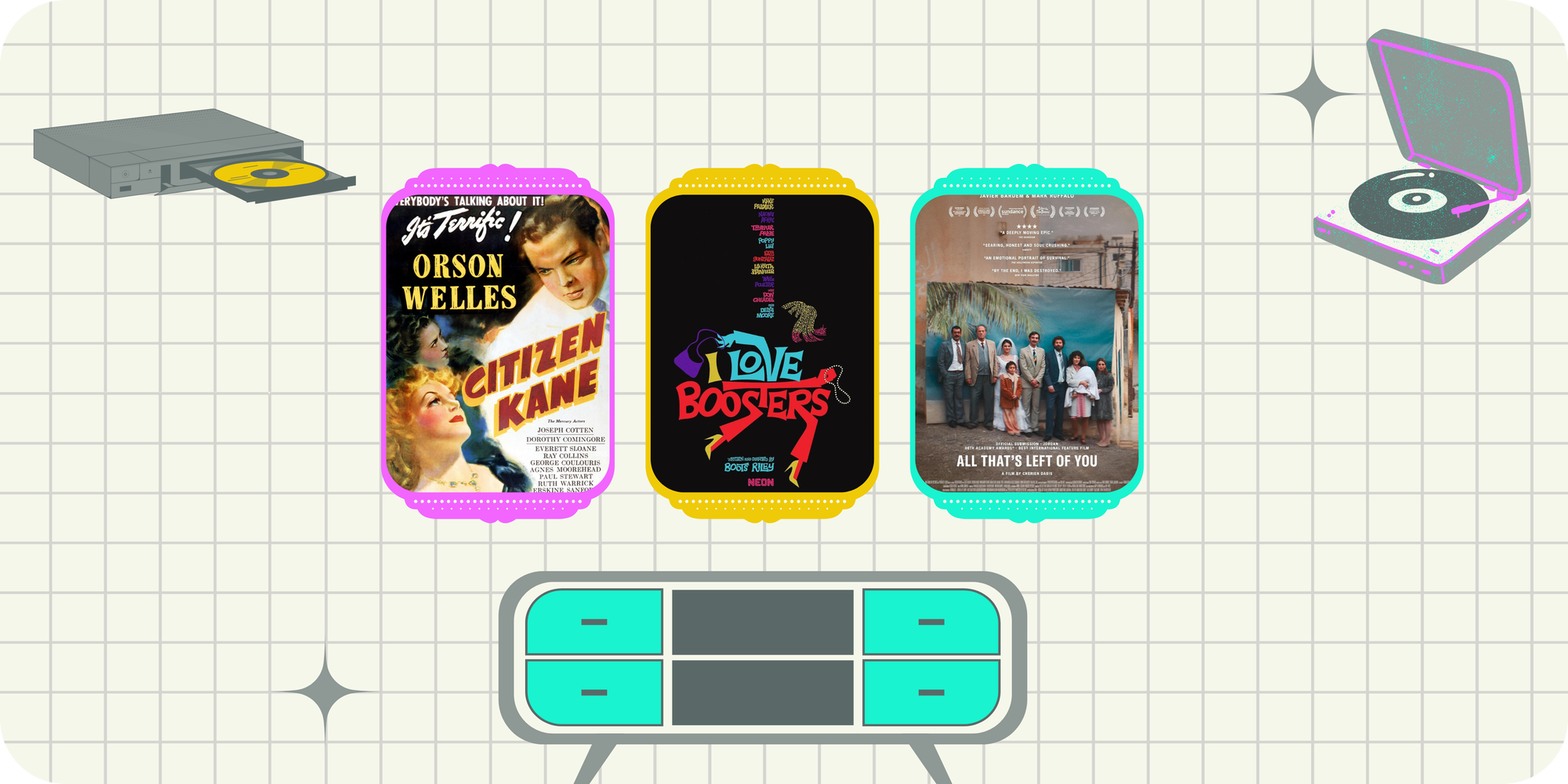
- Citizen Kane (1941): Currently back in theaters for its 85th anniversary, this classic movie about the fictional Charles Foster Kane (loosely based on yellow journalism tycoon William Randolph Hearst, among other contemporary figures) is widely acknowledged as a masterpiece of filmmaking. The production deal that allowed Orson Welles to write and direct this as his debut is still regarded as one of the most favorable to a filmmaker in the history of the industry.
- I Love Boosters (2026): Boots Riley’s colorful celebration of informal markets and worker organizing has a wildly watchable cast, a principled message, and impeccable style and design with his trademark enjoyment of practical effects. It’s available on demand now!
- All That’s Left Of You (2025): This heartwrenching multigenerational story of a Palestinian family, made by and starring Cherien Dabis, faced challenges in production and distribution — it had begun filming in Palestine but had to stop in October 2023 with the onset of the genocide and recreate the setting elsewhere. The film is now available through independent distributors and platforms such as Watermelon+ and Letterboxd Video Store.

- Tue., July 14, and Wed., August 5, 2026: Dr. Sarah J. Jackson Book Tour for A Second Sight: How the Wonder and Vision of Black Mediamakers Push America Toward Freedom (in-person: Brooklyn, NY & Cambridge, MA)
Media scholar Sarah J. Jackson charts the extraordinary cast of Black journalists, photographers, filmmakers, radio hosts, podcasters, and other mediamakers who have drawn on the visionary tradition of “second sight” to advance democracy and broaden our most fundamental American values.
- Thu., July 16, 2026: Little Sis & Oligrapher Training (virtual)
4-5:30pm PT / 7-8:30pm ET
The LittleSis research database is a movement tool and resource that brings together publicly available data about corporations, billionaires, and power structures. Oligrapher is a network visualization tool that is integrated with LittleSis to help users build power maps. Join them if you’re interested in using these tools for your campaigns!
- Sat., July 18, 2026: Barrio Television: Work in Progress – a screening and panel discussion
2:00pm ET
125th Street Library | 224 E. 125th Street, New York, NY 10035
Check out the forthcoming documentary on the remarkable story of how Puerto Rican activists created the first Latino bilingual public-affairs show on TV. Author/advocate/friend of The Revival Lab Joseph Torres is executive producer and he will join the film's director, Christina DiPasquale for a discussion after the screening.
- Tue. and Thu., July 23 and 25, 2026: How to Fight Data Centers Webinar Series (virtual)
Honor the Earth is running two interactive webinars on resistance against hyperscale data centers. The first, Campaigns 101, will go over how to build an effective campaign. The second, Data Center Interventions, will dive deeper into the strategies that have been successful at stopping data center construction on a local and state level.
- Fri. & Sat., August 14 and 15, 2026: Gatekeepers of Truth: Artists and Archivists in Paul Robeson’s America (in-person: Philadelphia, PA)
This two-day conference will allow participants to explore archives as sites of struggle, memory and cultural power, rooted in Paul Robeson’s insistence that artists are never neutral.