Precedented Discoveries & Crisis in Context
Reflections from the History of Science Society Meeting
Last month, I had the opportunity to attend the annual meeting of the History of Science Society (HSS) in Edinburgh, Scotland. HSS is an international society “dedicated to understanding science, technology, medicine, and their interactions with society in historical context.” It is the oldest organization of its kind, founded in 1924 and now headquartered in the U.S. Edinburgh, with its strange and varied history of science and medicine, was an apt location for this convening of over 2,000 attendees.
Studying the history of science has provided me with useful and strategic context on the political, cultural, narrative, and economic power of science and technology. I came away from the event with a better understanding of how scholars studying the history of science seem engaged with addressing or intervening against certain key traps:
- The exceptionalization of “crisis”
- The narrative of inevitability often assigned to scientific or technological developments
- The idea of objectivity or indisputable truth
- The attachment of knowledge or authority to individual heroes or experts
- The unsustainability of centering the United States
If these ideas are interesting to you, we hope you’ll join us at The Revival Lab in thinking with them as we conduct research in service of power.
Your generosity fuels our newsletter and research, strengthening the movement for media, tech, and information justice.
Donate now and join the revival today!
Academics’ and social scientists’ perception of crisis
In a keynote panel early in the conference several professors discussed the present and future of the history of science as a discipline. The moderators often returned to the “ongoing crisis in the academy,” inferred to mean right-wing targeting of professors, austerity politics, and defunding of research, among other factors, as part of a global anti-intellectual agenda. Some professors challenged this framing, wondering aloud whether their peers considered this crisis in the academy a part of broader social conditions or as a singular and primary cause for concern. They called for scholars to consider their responsibilities not just as intellectuals but as members of their respective communities, using one identity to inform the other and vice versa.
Other panel discussions also called into question the tension between calls to protect the academy and the understanding that academia could be elitist, precarious, extractive, and exploitative. Overall, many people cited specificity as a useful intellectual intervention in understanding the crisis, and therefore in fighting it — what conditions of this crisis are precedented, and what could they be compared to? How can sensationalization or dramatization create urgency for action or detract from the ability to combat harm? Is crisis a singular event, or simply a way to make sense of myriad conditions within a period of time?
Narratives of inevitability
Several presentations focused on bringing to light institutional or individual actions behind scientific and technological development. In line with similar dialogue and political education efforts by community organizations and advocates, these scholars analyzed how political and corporate institutions created black boxes of unchecked research and development and dismissed critics and regulators seeking transparency or accountability as uninformed or ill-equipped to process the profound potential of their work. Some people investigated how developments in nuclear science and space exploration were treated as inevitabilities, which also invited comparison based on the fields’ overlap with military operations and priorities. Their findings also included examples of scientists and experts being used to further that narrative. A linear story of progress and discovery could be used to justify and make invisible active efforts to steal land, disregard environmental impact, and subjugate people.
Some Q&As and informal discussions invited the scholars present to interrogate how to challenge that idea of inevitability rather than allow themselves to be used as the types of experts that lent credibility to unchecked corporate or state research and development. Several presentations I encountered cited historical examples of how social movements pushed back on the idea of hegemonic expertise without feeding into anti-intellectualism, demonstrating a role that knowledge producers could play in contesting power. Others gave specific examples of developments that had been characterized as inevitable, or whose origins had been intentionally or mysteriously erased from public understanding — the characterization of data as a commodity or property, the construction of data centers, the seizure of land and resources for rocket launches, and more. As a more abstract starting point in embracing their roles in bringing these origin stories to light, one panelist called for historians of science to make political decisions in their work, or rather acknowledge that their decisions were political in nature.
The false promise of objectivity
One topic of interest raised by Prof. Adrian Johns from the University of Chicago during a panel involved concerns about AI-generated images manipulating truth. He specifically offered the challenge that images have always been used to create narratives, and the push to codify “truth” often fails to acknowledge that no images or historical archives can unequivocally capture a complete, objective truth. For example, historians of medicine have highlighted how anatomical diagrams and photographs might have been compiled in exploitative ways and used to inform biased or misleading consensus on treatment.
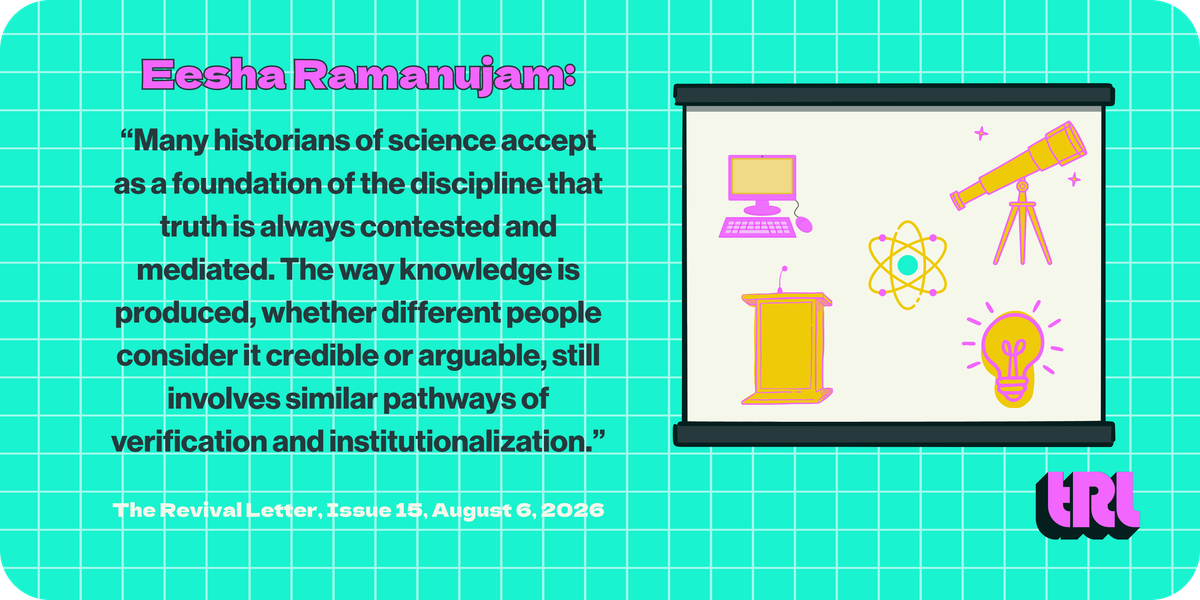
Here at the Revival Lab, our ongoing research seeks to contextualize individual instances or campaigns of disinformation or media manipulation within material conditions, assessing how power informs trust or what people decide is true. This concern is reflected here — many historians of science accept as a foundation of the discipline that truth is always contested and mediated. The way knowledge is produced, whether different people consider it credible or arguable, still involves similar pathways of verification and institutionalization.
AI-generated or AI-altered images present particular threats and concerns that must be addressed, but they are far from the first pictures to be mistakenly assigned objectivity; those who consult photographic archives have long identified the need to address what is outside the frame, or the specific choices used by photographers and artists in composing or even labeling an image. This merits further exploration, but for the purposes of this reflection I’ll just say that these observations don’t mean that it is necessary to approach the world with an exhausting layer of distrust and suspicion. In my view, it just means that people assign power to images, and we can use that tactic in thoughtful ways rather than aspiring to some universal idea of objective truth in our interpretations.
Individualizing knowledge & scientific “heroes”
The idea of trust and authority being assigned to singular experts or those who made one-off momentous discoveries reflected, to me, a common discussion in social movements about the idea of a charismatic leader. While individual people play important roles in any effort for justice and can often garner attention with their specific stories and strengths, assigning disproportionate or superhuman power to any one person can sometimes be a tactic to exceptionalize a movement and discourage others from trying to duplicate its wins. In this conference, scholars repeatedly brought up declining trust in institutions and experts, often beginning or gaining traction with the discrediting of single figures, previously assigned overwhelming credibility or authority.
In a more reflective mode, panelists and attendees also brought up their own challenges of producing knowledge and demonstrating authority in a capitalist intellectual economy. They described the tensions of characterizing their own research, not wanting to over-promise but also needing to assert their relevance and potential reach in order to secure funding. Several people alluded to the anxiety of needing to demonstrate authoritative expertise in their field to conduct the research they cared about, and the risk to themselves and their work that could come from presenting themselves as potential targets for anti-intellectual or other bad-faith criticism.
Addressing the Americentrism of the academy
While regimes and social movements are attacking prominent intellectuals across the globe, several scholars (considering a significant percentage of the attendees were American) returned to the perceived accelerated crisis — as discussed above — in the U.S. Specifically, a number of people engaged with what they characterized as the Americentrism of the academy generally, and the prioritization of American scholarship and American issues across disciplines. American historians somewhat universally condemned the “America First” nationalism of the federal government and its adjacent institutions, addressing among other factors the loss of meaningful discoveries that might come from true cross-border collaboration.
Beyond calls to support their colleagues in America dealing with challenges ranging from department closures to deportation, several people suggested that this moment presented an opportunity to refocus the collective attention of their discipline on scholarship from other places, and to reduce their reliance on American institutions. Some more passively observed that they assumed a new global knowledge power was likely to take center stage, citing Russia or China as examples.
It was interesting to take in how people outside the U.S. viewed its political and intellectual landscape, and how American academics as a category were seen as marginalized or privileged, now or generally. It was also fascinating to hear scholars debate how dialectics or comparisons could be useful or reflect limiting binaries — East vs. West, Global North vs. Global South, core vs. periphery, colonizer vs. colonized. I appreciated some presentations that delved into the U.S. less as a monolith or a center of gravity, but as a site where Indigenous and Black scholars produced knowledge in conversation with researchers from other colonized and marginalized communities across the world.
Conclusions
Attending HSS’s meeting prompted entirely new lines of inquiry and exploration for me. I hope my attempt to capture some of the toplines of discussion can do the same for those reading. After the conference, I was thinking about how the Revival Lab’s ethos (as cultivated by Brandi Collins-Dexter) and my training and experience as a researcher inherently resist perceived barriers or silos between scholarship and practice. I’m left wondering where “the academy” does or doesn’t fit in that relationship, and I’m inclined to think that the obvious answer concerns the individual scholars within it and not the institution overall.
I have observed an ongoing concern in advocacy groups and community organizations grappling with how to communicate urgency as a way of pushing others to act or react without compromising the integrity of their message or burning people out. I’ve experienced the push and pull between organizers and researchers — though I’d challenge the complete differentiation of those two roles — as they work to balance rigor and momentum.
I’ve always seen my role as a racial justice researcher informed by labor movement frameworks as keeping the receipts and creating meaning from them. I have always had to balance my curiosity with other goals, specifically building political power. In having the chance to meet more people working between universities, nonprofits, think tanks, community formations, and so many other spaces, I am excited to think through how our approaches can inform each other.
My impulse is always to develop the right question to inform a research pathway, and I’m left with this one at this time: how can our scholarship reach the people who can use it as an input to their strategy or as leverage to contest power?
Scholars of interest
If you are interested in these themes and would like to learn more, The Revival Lab has compiled a list of presenters from the conference whose work may be of interest to our readers. Please reach out to info@therevivallab.org if you would like some suggestions. Note: Since many of these scholars work within academia, a significant amount of their published work requires academic credentials or university library access to read.
###
Eesha Ramanujam is the Research Director at the Revival Lab.

- Hammer & Hope’s Issue No. 11 — Various Authors, Summer 2026
In our last newsletter, we recommended Robin D. G. Kelley’s piece in Hammer & Hope reflecting on the Declaration of Independence from a Black radical perspective. This time, we’d love to uplift Hammer & Hope’s entire summer 2026 issue and encourage readers to subscribe! Some of our favorites: two forums sharing varied perspectives on Mayor Zohran Mamdani’s performance and on the legacy of writer and musician Greg Tate; a reflection on resistance to ICE invasions as it currently stands; a review of Cats: The Jellicle Ball on Broadway (which — full disclosure — I recently watched and adored); and a profile of director Boots Riley, whom we also discussed in our last issue. (Hammer & Hope is a magazine of Black politics and culture. Donate to Hammer & Hope.) … Recommended by Eesha.
- Dead at McDonald’s — Alex Park, Oakland Review of Books, July 29, 2026
This essay centers on an abandoned McDonald’s and its place in the history of East Oakland. It’s a sweeping narrative that features the Black Panthers, Jonestown, and so much more. (Oakland Review of Books tells the authentic stories of Oakland. Subscribe here.) … Recommended by David.
- Anatomy of an AI Kill Chain — Sophia Goodfriend, Heidy Khlaaf, Namir Shabibi, Joe Dyke, and Nathan Walker, Airwars and AI Now Institute, July 28, 2026
This interactive project shows the deadly consequences of increasing AI use in the American war machine. In extreme detail it lays out clearly the chain of events that make up an AI targeting cycle and how errors can easily occur. (Airwars is a nonprofit transparency watchdog for conflict-affected nations. Donate here. AI Now Institute an independent research institute that reimagines the future of AI. Find out more.) … Recommended by David.

This recurring section is designed to highlight some of the best critical work coming from a new generation of creators on YouTube fighting back against corruption and fascism. Left and progressive content creators, many of whom are young men, are speaking up and acting out in a popular front against the redpill manosphere, MAGA propaganda spox, and white nationalist trolls. Each issue, we’ll recommend an independent journalist or news influencer to follow to enhance your YouTube recommendations, and help signal-boost some of the best creatives who are speaking truth to power.
Doomscroll: David Harvey
This week’s selection is a slow burn with a living legend. Renowned Marxist scholar David Harvey sits down with Josh Citarella, art theorist and host of the Doomscroll podcast for a live interview as part of this year’s Whitney Biennial. Harvey draws from his decades of economic and social theory to help explain the mutating neoliberal present. Moving across epochs and technologies, Harvey and Citarella show the value of keeping a materialist critique in our toolkit as tech monopolies and complicit state actors implement even greater control over our speech and labor power. Citarella’s Doomscroll regularly features provocative voices from the left, and is worth a follow for its deep dives into the ideas animating the progressive insurgencies happening right now across the country.

- Fri. & Sat., August 14 and 15, 2026: Gatekeepers of Truth: Artists and Archivists in Paul Robeson’s America (in-person: Philadelphia)
This two-day conference will allow participants to explore archives as sites of struggle, memory and cultural power, rooted in Paul Robeson’s insistence that artists are never neutral. - Sat., September 19, 2026: Fighting TechnoFascism: Power, Surveillance, and Resistance (in-person: Chicago)
A one-day convening hosted by MediaJustice and Mijente, bringing together nationwide organizers fighting energy-sucking data centers, the surveillance state powered by Flock, and tech-enabled mass deportations and murders.

 The Revival Lab
 The Revival Lab