
The Overseer Class: A Conversation with Dr. Steven Thrasher
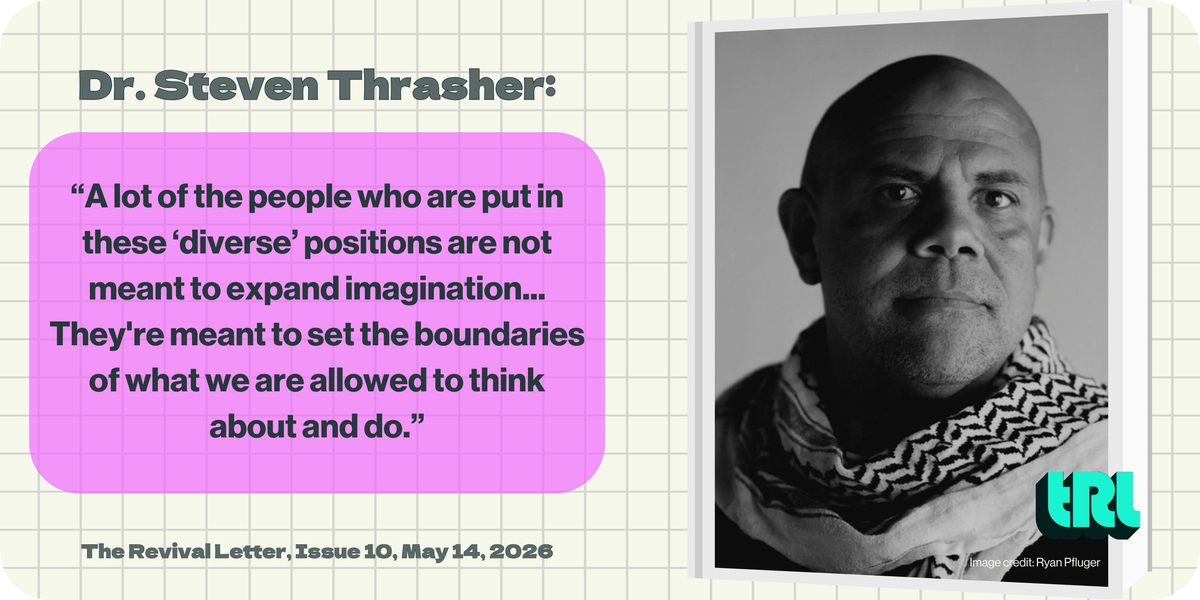
For this week's issue, we had the chance to speak to Dr. Steven Thrasher — activist, professor, self-described "itinerant preacher," and best-selling author of The Viral Underclass: The Human Toll When Inequality and Disease Collide, a profound work of scholarship and storytelling excavating the social and economic factors impacting health outcomes. Our conversation was so expansive that it will be split into two parts; the second will be published tomorrow. Read on for an introduction to what Dr. Thrasher calls "the overseer class," members of historically marginalized communities that are granted higher visibility or institutional access.
This conversation is a part of Dr. Steven Thrasher’s tour promoting his newest book The Overseer Class: A Manifesto, which will be available May 19th from Amistad. The following interview has been edited for length and clarity. (You can read Part 2 of the interview here.)
Thank you for speaking with us about The Overseer Class! You start the book by identifying these key categories — police, mass media, universities, corporations, military, and politicians. What role do you think visibility (or lack thereof) plays in the success or failure of these different categories of overseers? I think it's very intentional that you have police as a hypervisible version of this, and then you talk about mass media.
It's a huge part of it because when we think about representation, we're thinking about what we're seeing and what's in our purview. This actually began as a book about police, and then about conceiving of policing in different domains. There is something about literally seeing Black or queer faces in high places that affects the sociality of our environments and how we perceive and experience power.
I try to draw a distinction in the chapter about business that I think is very important — even more so probably than when I began writing the book — understanding critiques around things like DEI (Diversity, Equity, and Inclusion). I try to say explicitly that I have my criticisms of how DEI can be used as a corporate tool. I have my criticisms of how it's sometimes used to create an overseer class, but those are distinct arguments from the Trump administration running roughshod over DEI and really doing so in explicitly racist ways.
I hope the book is a thoughtful criticism of representation and diversity, which does not mean that those things are not important. But diversify from what? Even the word diversity itself is important, but to ask that question, at least, helps us think about how the default setting is usually white, or the global minority.
I don't want to downplay or make people feel bad for thinking it's important to see different kinds of people access different kinds of jobs. And in a joyous way, I think it's important for America and humanity to have seen Christina Koch and Victor Glover, as a woman and a Black man flying around the moon [in Artemis]. I think they're a good example because the experience and joy of seeing them isn't about dominating others. They're not now king and queen of the human race trying to lord down on everyone from the heavens. They are showing us the joys of art and science and exploration, in this way that really increases the capacity for imagination.
But a lot of the people who are put in these “diverse” positions are not meant to expand imagination. They are meant to rein in our imagination, and they're meant to set the boundaries of what we are allowed to think about and do. That's a lot of what I'm criticizing in the book: when we see representations of Black people in film and TV, why are they so often police officers? When we see them in government positions, why are they often limiting other Black people and being put forth in positions where they are limiting our imagination?
I think I begin with cops because that was the genesis of the book, but often even if we're talking about higher education, or we're talking about corporate America, or we're talking about the news media, it is often a policing mindset and a policing representation in some way. That’s what I’m really trying to wrestle with.
Your generosity fuels our newsletter and research, strengthening the movement for media, tech, and information justice.
Donate now and join the revival today!
That makes sense. You start the book with this anecdote about hoping to join the NYPD and specifically citing their participation in Pride, showing this clear effort to portray themselves visibly in a particular way. You also later talk about an incident with Black and Asian police officers you perceived as trying to prove something. It’s interesting that these groups are portraying their proximity to an identity in these very different ways, as either close or distant. How did you start to think about that intimacy with or distance from identity-based community for the overseer class?
There’s a quote at the beginning of the book by James Baldwin that I come back to often about how cops from [racialized] groups have to prove to themselves and to others that they're not like that, that they’re really closer to whiteness. The incident you're talking about is when I was beaten up along with a number of other faculty at Northwestern. I was physically beaten up by a Black cop, by the chief of police, but there was also this Asian cop there. And these are all my interpretations; I can't speak to what was actually going on in this person's head. But the professor to the left of me was also Asian. The Asian cop was on them, and the Black cop was on me, and I was seeing this very similar dynamic to what I was experiencing. I think when those kinds of people are given that police power, they have to prove to themselves and to others that they're not giving special treatment.
As I read decades of research about race and policing, that's exactly what sociologists have found when they've talked to Black cops and others. They have to show, “I'm going to be even tougher on the Black teenager or the Black young man or the Black woman so I don't get in trouble.” Some very honestly add, “and they annoy me the most.” So some of them are very explicit about owning their emotions in that way.
Also, as a gay person who's reported on the NYPD, and as a gay scholar, I'm aware that Stonewall began as a riot against the NYPD. Now you have the NYPD marching in the Pride parade. Something I've really wrestled with, both as a citizen and as a viewer and maker of media, is that a lot of people hear about community policing, and they think it would be better to get people from different communities in the police. So maybe they're not so violent with everyone. They get to know the community better. And there's an argument for some of that. But the real goal of that is to be able to more intimately surveil the community.
One of the movies I write about in the book is Cruising, which is a William Friedkin movie where Al Pacino goes undercover as a gay cop. He’s trying to solve a murder, but the thing you also learn from this is that the gay cop is going to have so much more surveillance ability in the S&M world or in these kink worlds. He will be able to surveil the community far beyond the alleged crime that's being investigated. When a cop comes from a community, they're able to do that surveillance in a more intimate way.
Robin D. G. Kelley, the historian at UCLA, has a great line that he wrote in response to my book about how our ancestors always knew that the master's first line of defense was the overseer. And the closer that that defender is to the community, the more intimately they can also defend the master's interest. So I think I'm trying to have a class-based analysis of policing, in the way that people in the United States overall have been more critically understanding and thinking about the role of policing over the last 10-15 years. I think Black Lives Matter has been responsible for this. Activism in 2012, when Trayvon Martin was killed, in 2014, when Mike Brown was killed, in 2020, when George Floyd was killed, and also through Occupy Wall Street and around COVID and ICE, has really helped the American people to much more critically understand and question how resources are going to police. This has made many people more open to the idea of, if not fully abolishing the police, then at least moving resources from the police to other areas, like having mental health checks done by social workers instead of by police.
A way that the ruling classes try to reel that back in is by diversifying the police. That's where I think there's a real tension: in understanding that the project of diversifying the police is allowing the ruling class to maintain the status quo, and to maintain the way that police defend extraction of value from the working class upwards.
You start the book talking about police, and then later, you also bring up the armed forces. You talk about the faces of leadership, as well as what it means to be a rank-and-file member of this force. And you talk about it from a complex perspective — you talk about all these complicated ways that people resist American imperialism and are racialized in different ways because of that, or are subject to racialized violence that they might not have been subject to otherwise.
It seems like there might be a hesitancy to talk about something like the overseer class in the context of the military because when it comes to joining the military or the police, there's this varying degree of vulnerability. There are people who are genuinely invested in changing the nature of a force that seems to have so much impact on their lives, that is very intimately involved in their communities, whether they like it or not. And for others, this is a way out of a pipeline that they have been dropped into because of poverty, or because of other forms of discrimination. I'm curious about what you saw as the importance of bringing that frame of the overseer class into this discussion of the armed forces in particular, in making decisions as well as participating in imperial violence.
I thought it was important for a few reasons. Probably the most immediate is that I am complicit and I benefit from it. And I realize even just at an emotional level, I have a visceral skepticism of policing and of people who choose to be police that I don't have of people who've been in the armed forces. I wanted to understand why that is. I also realized I'm of a generation of Black Americans whose social mobility was very tied to this. My father could not get other work and was in the Air Force for 13 years. He also wanted to be a police officer and that was not a viable road for him. He eventually became a teacher and became extremely critical of both police and of the U.S. military.
I'm also interested in the U.S. military organizationally because it is an extremely fair employer. If you look at the demographics compared to most fields you and I have worked in, journalism or academia or research, these are extremely exclusionary institutions. And not to downplay its importance, but just for the sake of conversation, putting aside for a moment how the U.S. military gets its bounty, the bounty that it gets, it shares pretty fairly as an employer with the U.S. population. Racially, it matches almost exactly in lots of categories. Not with women — there's a pretty big gender dynamic between women and men. But it employs a significant number of LGBTQ people, and since the end of Don't Ask Don’t Tell, when Trump hasn't been president, it's been the largest employer of trans people in the world. So I thought it was really interesting to think about how when we talk about diversity as a good, this is the biggest employer in the U.S. that actually does that.
But what is that pulling you into at the same time? I do try to really draw distinction there using an overseer class framework to say there's differences between the different people we're talking about. An overseer in this setting is General Colin Powell or Secretary Condoleezza Rice or General Lloyd Austin. Maybe sometimes a commanding officer would be something we call a driver. They were sort of middle management on plantations. But I don't think of the grunt soldiers as overseers. I think that they could be absorbed upwards into that, but they are also often victims of the same system. When we think about race as a container, Black soldiers could see themselves with other Black people in other countries they're having to wage war against — that's where we often do see people acting as conscientious objectors — or they could see themselves in alignment with the Joint Chiefs-of-Staff. I'm interested in whether that racial category is getting made or crafted laterally between different countries or happening vertically.
Something that I explicitly do say in the book — I have only had this idea and I need to do more research, but it utterly fascinates me — is that I've noticed that many people, including my father, go through the armed forces, and then end up being extremely critical of the military and speaking about it, making films about it, writing books about it, doing activism about it. Often, in my years of working as a journalist, the most strident anti-war activists were U.S. veterans. I don't see that with the police. I want to do deeper sociological research on that. I write about Aaron Bushnell, [a military veteran] who took his own life. Obviously, he did something very extreme, but it actually felt very familiar to me in terms of other stories I've written about veterans. They have these really terrible experiences and they come home and they have a kind of community with other veterans that is actually a good thing, a broad socialization to go in a different direction. And I don't see that with former cops, even former cops who write stories about bad things about police. In my experience, they don't ever go to the level of abolishing the police. Their framework is usually, well, we could make policing better. But it's not unusual for me to see veterans say that the whole [system] has to come down. This is an imperial project. And so I'm very curious about how and why that happens sociologically. One of the harder parts for me when editing the book was coming back to things I'd written about Aaron and realizing 18 months later, the [Palestinian] genocide's still going on. This person gave their life and they're gone. And all this time later, what they gave their life to stop is still happening, and that was a very difficult thing to wrestle with.
Being confronted with the reality of what has and hasn't changed is very intense. You mentioned this sort of about-face that happens when people in the military end up at the nexus of anti-war organizing, often participating in veteran movements. Thinking through how people react to members of the overseer class, it's so much more personal. A lot of the frustration in the book is about people that you perceived yourself as having a kinship with or having some sort of relationship with because of your shared experience. It seems that they're the most likely to make people from their communities feel either the most betrayed or the most seen. How do you make sense of that polarization?
The connection of an overseer is supposed to be intimate, and it's supposed to buffer exploitation. I write about going to the Whitney Plantation, which is the only plantation that's been turned into a museum of slavery. I was also listening to Viet Thanh Nguyen’s memoir, and he wrote about not understanding how people could experience the humidity of Vietnam when he returned. I had the same feeling when I was on this plantation and I was like, how did my ancestors work in this? I'm melting just walking around. And then when you go into the big house and it's so cool and calm, you realize the person who owns this is not going to be managing the fields. He needs a buffer, and that is the overseer. Not to crudely flatten modern workplaces, but all of the techniques of the plantation — the technologies and the procedures that were developed under the lash of a whip — they still exist. They just morphed into a form of management relationships. One of the best techniques to manage between the person who owns everything and all the people doing the work is some kind of intimate connection. And so often they are exploited through a shared identity. That's why it can be very disappointing.
My editor, Abby West at Amistad, also shared with me a line that I put in the book about how it can really hurt when you think someone is going to be your kin, and instead you realize that they're there to keep you in line. You might not have had that feeling about someone that you didn't share these characteristics with. So the existence of the relationship itself is predicated on creating an affinity and exploiting the affinity. That can really hurt, especially when you realize that the person you thought was close to you is only using it for their benefit. They are not using it to help you.
In the book, I often say that people who have been groomed to be overseers have power. To me that's part of what differentiates them from a token. They are in positions of power, and they could just say no.
I like to say nice things about people once in a while. The president of Boston University, a Black woman named Melissa Gilliam, rolled out this policy of everything needing to be content-neutral. No one could put anything in their windows and they went around taking down all these rainbow Pride flags on campus. Then students put up more. Eventually she said she was “deeply sorry,” and apologized to the LGBTQ community. And it was so refreshing to see somebody do that because when I first read it, I thought this was going to be another overseer. I think probably part of the reason why she was hired was to rein in student dissent. But people in those positions can say, no, I'm going to either risk my own job or just assert the power of my job. I know what it means to come from a marginalized community and the importance of being able to affirm myself with some kind of symbol. And because I'm in this job, I'm going to defend the right of others to do that. That is the direction things can go. They just often don't.
For more of Dr. Thrasher’s thoughts on student protests, social movements, and the “class” aspect of The Overseer Class, as well as his influences and inspiration, check out Part 2 of our conversation!
###
Dr. Steven Thrasher is a journalist and scholar who writes about structural inequality, social justice, and LGBTQ issues, including but not limited to HIV/AIDS, policing, and queer methods.
Eesha Ramanujam is a Project Advisor at the Revival Lab and a media and tech accountability researcher, currently completing a Masters in Social Sciences at the University of Chicago.

The Overseer Class – Steven W. Thrasher Book Events (times local)
If you liked the interview above and would like to hear Dr. Thrasher talk in person, there are several opportunities coming up this month.
- May 19 – w/ Samhita Mukhopadhyay, The Strand, New York – 7pm (RSVP)
- May 20 – w/ Donovan X. Ramsey, Charis Books & More, Decatur, Ga. – 7:30pm (RSVP)
- May 21 – w/ Adam H. Johnson, Pilsen Community Books, Chicago – 7pm (RSVP)
- May 27 – w/ Lisa Snowden, Red Emma’s Bookstore, Baltimore – 7pm (RSVP)
- May 28 – Politics & Prose, Washington, D.C. – 7pm (RSVP)
Security to Wellbeing - Cohort Application
The Building Movement Project (BMP) has launched the 3rd annual Security to Wellbeing cohort slated to begin in July 2026 for direct service organizations. Through this cohort, BMP hopes to create a space of learning and community with service organizations and provide holistic support that turns lessons learned into applied action and positive change for the communities they serve. Applications are due May 15, 2026 — learn more and apply here.
LittleSis Upcoming Research Trainings
- June 4 - Power researching for your landlord - 7-8:30pm ET
- July 16 - LittleSis.org & Oligrapher - 7-8:30pm ET

- Corporate Power (entire issue) — The Forge and Liberation in a Generation, April 20, 2026
The latest issue of The Forge was handed over to Liberation in a Generation, and they have several terrific pieces built from their experience working to rein in the influence of corporate power on our lives. From defining alternatives to corporate power to identifying strategies to organize your community, there are tons of great resources worth checking out here. (The Forge is a nonprofit outlet elevating strategy and organizing. Donate to The Forge) … Recommended by David
- How Billionaires Captured the Media — Andrew Callaghan w/ Steven Renderos, Channel 5, April 23, 2026
In this sweeping interview, Steven Renderos, the executive director of MediaJustice, discusses how corporate oligarchs are buying up the media and what it means for us today and in the future. He also talks about ways we can stand up to the seemingly insurmountable power of wealth. (MediaJustice is a nonprofit organization fighting for tech, media, and information justice. Donate to MediaJustice) … Recommended by David
- Solidarity Syllabus: Honoring Alice Wong — Solidarity Is, May 8, 2026
This is a journey through the life and work of disability justice activist, storyteller, and community organizer Alice Wong, who passed away in November 2025. This syllabus shares some of her past writing, her calls to action, and ways to engage with the work and principles important to her. (Solidarity Is is a program of Building Movement Project, which provides training & tools for organizations dedicated to social change. Donate to BMP.) … Recommended by Eesha
- Jamming the AI Hype Machine — Amirio Freeman in conversation with Jai Dulani, Peace & Riot, April 2026
AI hype is all around us, but what will it actually do, and what are the costs? Amirio Freman and Jai Dulani cut through the bullshit to tackle these questions and more. (Peace & Riot is a nonprofit climate and environmental justice magazine. Donate to Peace & Riot.) … Recommended by David
- Living for the City Ep. 1: The Assembly Line That Built Motown, Techno, and Hip Hop — Hanif Abdurraqib, Side Stage, May 13, 2026
This new podcast from MacArthur Fellow and acclaimed writer Abdurraqib dives into the rich, textured musical history of Detroit. The first episode zeroes in on the relationship between labor and art — the labor that made the paradigm-shifting music of Detroit possible and the role of working class people in creating and celebrating it. … Recommended by Eesha

The Revival Lab envisions digital spaces as extensions of the connections we build in real life, rather than as poor substitutions. We hope you see this recurring segment as us rummaging through the shelves under the TV or leafing through a CD case to hand you what we’re watching or listening to.
Selected by Eesha
- Let the Fire Burn
- Yesterday, May 13th, was the anniversary of the 1985 bombing of the MOVE house in Philadelphia, when the city’s police department targeted a Black revolutionary organization with explosives that ended up killing 11 people (including five children) and destroying 60 nearby homes. This 2013 documentary includes archival footage, interviews, and news coverage of the bombing and the events preceding it. Available through individual library access on Kanopy and for rental.
- Steal This Story, Please!
- This documentary on Amy Goodman and the origins of Democracy Now! is endlessly compelling, informative, and galvanizing. In a departure from our usual for this segment, we are recommending this when it is available to watch in theaters rather than at home — we hope you’ll take the time to experience it in community, especially since many screenings are being co-hosted by local independent media outlets worth learning more about. Shout out to our friends at the Invisible Institute, who co-hosted in Chicago!