
“I’ve Had Enough”: How Data Centers Are Mobilizing NC Voters

“I think about selling every damn thing I got because of y’all.”
The crowd of over 200 fell silent as the man pounded his fist on the podium. “I’ve worked all my life, all my life, trying to carry on the family tradition!” His white hair, tied back in a loose ponytail, jostled behind his shoulders as he continued, not wasting a second of his three minutes.
He pointed at the Lee County Board of Commissioners in North Carolina. “And now, because of you sons of guns—especially you, Kirk,” he shouted, jabbing his finger at Commissioner Kirk Smith. “I've had enough of you.”
“We're getting ready to vote your ass out of here," he yelled, growing more agitated.
Mark Mansfield is a third-generation landowner on Lower Moncure Road. He told me earlier that week that he had inherited the land from his grandparents and had done his best to maintain it. Lower Moncure is located along the northeastern border of Lee and Chatham County, a rural swath of forest and farmland. The Deep and Cape Fear Rivers run along the eastern border, with creeks interspersed throughout.
This was Mansfield’s first time speaking at a public meeting. In 2025, he reluctantly accepted news of a business park being built down the street from his home, thinking it was better than more housing. But the plan had morphed into a massive 430-acre, $900 million data center complex. He’s not alone in his frustration with the change, which prompted him to attend this meeting and make remarks to the Board of Commissioners. Residents like Keely Puricz, Jennifer Garner, and Deb Hall have raised concerns about energy demand and land use with their elected officials for months, with some demanding stronger regulations before the project gets all required permits.
Jeff Kidd, a landowner and goat farmer whose property abuts the proposed data center site, has become a regular speaker at public meetings. Kidd and his wife, Amy, have been measuring sound levels twice a day around their property since July 7, worried about how the noise will affect their goats and wildlife such as deer, coyotes, and even the bobcat that crosses their land.
The county’s Unified Development Ordinance (UDO), which governs what and how builders can build, was updated in April 2026 to include data centers. The Kidds have been comparing their sound levels with the maximum allowed by zoning regulations to demonstrate how disruptive a data center will be. The maximum level has already been matched, the Kidds shared. “That’s when a plane is overhead,” she said. The Raleigh Executive Jetport is less than five miles from their farm. “Now imagine if that’s the constant level?”
Your generosity fuels our newsletter and research, strengthening the movement for media, tech, and information justice.
Donate now and join the revival today!
Trust and transparency
Since August 2025, I’ve been covering a rise in data center projects and corresponding protests in Central North Carolina, two geographic regions fondly known as the Piedmont and the Sandhills.
One of North Carolina’s smallest counties, Lee — named for Confederate General Robert E. Lee — has a darker recent history. In 2006, Ku Klux Klan recruitment flyers turned up in Sanford residents’ newspaper boxes, and in October 2022, about 16 masked Proud Boys, many in tactical gear, gathered outside a Sanford brewery to harass patrons at a drag brunch, a far-right protest that returned in 2023 with a pastor at the helm.
But now, a different kind of movement is emerging. Hundreds across this region have spoken out angrily against the sudden, growing footprint of data centers, and the lack of transparency is fueling distrust in local government as the midterms approach.
In September 2026, after 13 months of government bureaucracy, including joint planning board meetings and zoning law changes, Lee County issued a $185 million construction permit for PointOne Data Centers, a developer outfitting the space for CyrusOne, a global hyperscale AI data center company that will operate it.
This building permit marks Phase 1 of the proposed $900 million data center campus on Lower Moncure Road — a project that moved through the local approval process largely out of public view between the Sanford Area Growth Alliance (SAGA), the developers, the original property owners, and PointOne. SAGA is a nonprofit that contracts with local governments to facilitate economic development; the organization appears to have introduced the deal to the Lee County Board of Commissioners. SAGA CEO Jimmy Randolph said at the July 13 meeting that NDAs are commonplace in the group’s project recruitment. As a nonprofit, SAGA does not have to respond to public records requests, though it reportedly provides the records the city and county ask for, complicating the information landscape for journalists and the community. The county has responded to my requests for acknowledgement of NDAs, saying no commissioner or staff member has signed one pertaining to this or any data center projects, but the community's persistent belief in their existence reflects the distrust people feel toward the government.
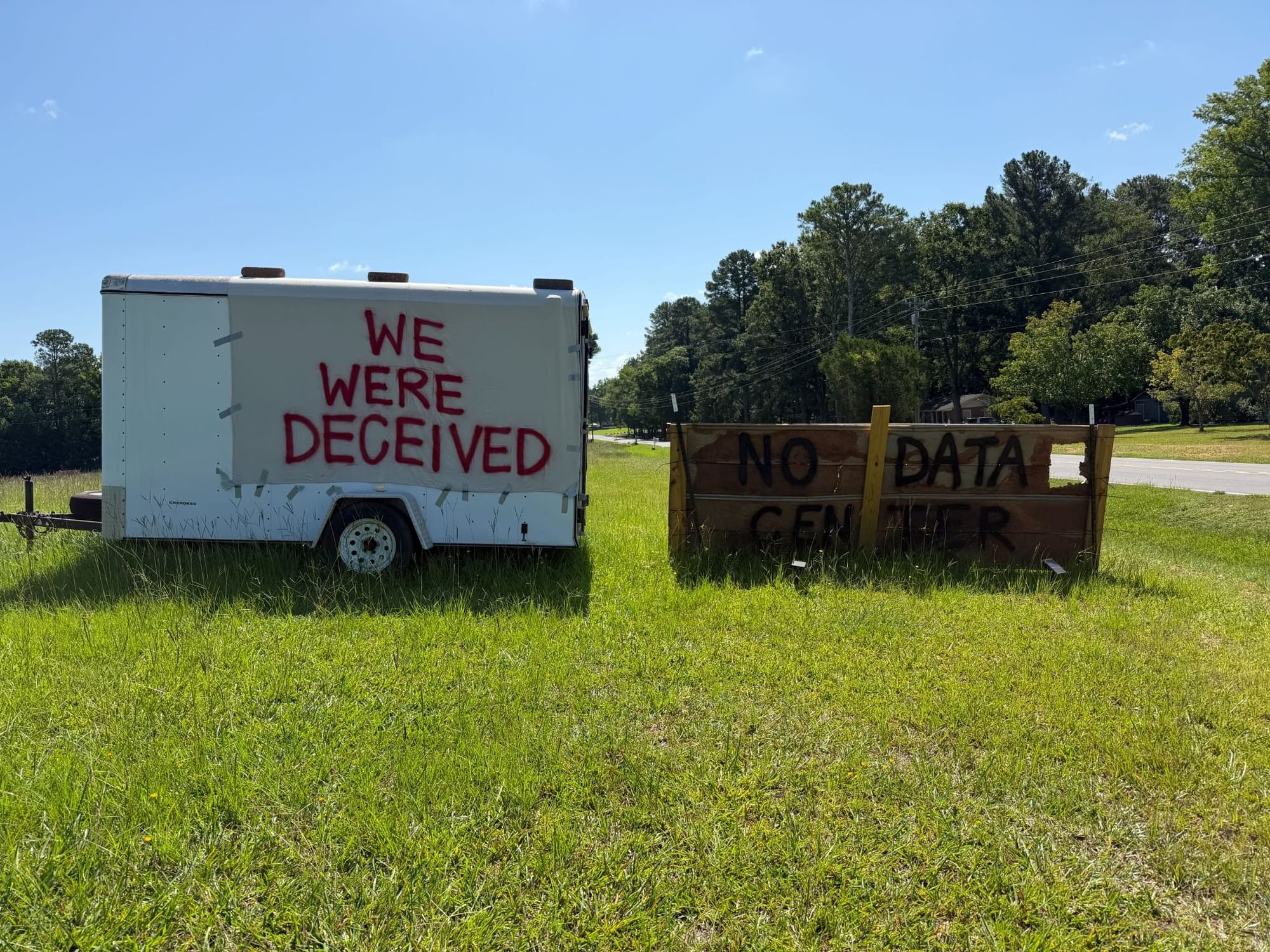
At the August 2025 planning board hearing for initial approval of the project, the developer described the site as a “light industrial business park.” According to a planning board member I spoke with, “they never mentioned a data center.” In March 2026, commissioners instructed county staff to research a moratorium, which they later presented, but the commission took no action.
The next month, the county adopted an ordinance creating a zoning approval process for data centers after several tumultuous public hearings, during which constituents expressed a desire for stronger regulations and requirements, as well as frustration with the momentum toward approval without sufficient investigation or disclosure. People were also frustrated to learn that four out-of-state data center consultants spoke in support of the UDO without disclosing that half of them, or their firms, were already working on the project’s permit application.
For residents who watched the moratorium exploration stall in March, who showed up to meeting after meeting only to see their commissioners and city councilmembers seemingly set their concerns aside, this was the last straw. At both city council and board of commissioners meetings, nearly two dozen speakers signed up to protest the data centers, condemn the commissioners' inaction, call for a moratorium, and demand that any nondisclosure agreements be made public.
Such secrecy is common in economic development: WRAL reported this fall, in coverage of the separate “Project Paragon,” later identified as the construction manufacturing company Caterpillar, that state law allows such deals to remain confidential and that officials often use code names to avoid discovery, even when documents are made public. My reporting on a Microsoft data center in Person County found that at least four county staffers signed NDAs with the developers.
Some residents are fighting back by directly challenging the power of these staffers and decision-makers. Matt Holway, a Moore County resident, is running for state office to address the corruption he has seen in the legislature over resource management. Jonathan Boyce, a Lower Moncure Road resident, decided to run against Commissioner Kirk Smith as an unaffiliated candidate, frustrated by a lack of trust and transparency around data centers and encouraged by his neighbors who have fervently supported his campaign.
Eric Evenson, a retired federal prosecutor and another Lower Moncure Road resident, collected 600 signatures on a moratorium petition in three days after the announcement of PointOne, then delivered it by hand to the Board of Commissioners in June 2026. Commissioners declined to consider the petition or other community efforts to slow the process and instead passed a resolution urging the state legislature to regulate data centers, claiming local governing boards lack the authority to enact effective statutes and are limited to zoning provisions like the April UDO, even as the planning department’s construction process for PointOne moved forward.
Neighbors along Lower Moncure Road and throughout the county worry about what this means for the air they breathe and the water they drink. The site plan lists 16 backup diesel generators and a water demand of at least 250,000 gallons — twice what PointOne indicated its usage would be in June of this year and equivalent to the daily indoor water consumption of roughly 800-1000 households, even if it's part of a closed-loop system which CyrusOne has proposed — and that number does not yet account for 10 more buildings.
Whose power?
North Carolina has 26 electric cooperatives. These nonprofit utilities are collectively owned by the people they serve and power homes, farms, and businesses in 93 of the state’s 100 counties.
Central Electric, a member-owned cooperative serving five counties (including Lee), is contracted to build the substation for PointOne’s data center campus. The cooperative says it can serve the project’s first building without adversely affecting existing ratepayers. PointOne representative Kelsey Fehr told The Rant that CyrusOne, the planned operator, will cover the costs of serving its projects. But residents worry that such an assurance would not be binding without meaningful regulation and accountability structures, and that compliance with it might not extend to the energy use of the entire development.
Duke Energy Progress is the region's regulated monopoly energy utility and owns the high-voltage transmission lines Central Electric relies on. At the October 5 board of commissioners’ meeting, Central Electric CEO and General Manager Eddie Oldham said the cooperative’s current “will serve” commitment applies only to the first building, not all 11. He said the next phase would require a transmission study by Duke, and if Duke commits to building out the power, Central Electric must build the substations to distribute it.
On October 6, Duke filed a large-load tariff settlement with the North Carolina Utilities Commission (NCUC) Public Staff, an independent state agency that acts as the official watchdog and advocate for utility customers. Amazon, Microsoft, Google, and Meta legally backed the settlement, which covers customers of 50 MW or more who sign service agreements after June 1, 2026. This includes Lee County’s data center campus. The Southern Environmental Law Center has argued that the settlement doesn’t do enough to ensure data centers pay their fair share for grid upgrades, instead establishing individual customer-focused protections too lenient to actually ensure cost coverage from larger customers. A decision is expected by mid-November.
Whose water?
In June 2026, I visited TriRiver's facilities, the regional water utility serving Sanford and Lee County, with Clean Water for NC advocates on a tour arranged by City Council member Charles Taylor. According to Stephanie Stephens, then-Riverkeeper for the Deep River, Taylor organized the tours to show the plants could handle a data center and ease the organization's concerns that TriRiver wasn’t ready to handle the heavy metals and “forever chemicals” released in a data center's wastewater. Taylor had also drawn some resident ire during public meetings for his role on the Joint Planning Commission in pushing to pass the data center UDO.
When I asked TriRiver’s facility leadership and public relations coordinator, who were present on the tours, I was told they were unaware of any “will serve” letters for a data center — the letters which would confirm that TriRiver can meet the water and sewer needs of a proposed development, required by the City of Sanford and the Planning Department. I later learned that PointOne had received the letter it needed for its application about a month earlier.
Walking through the Sanford Water Filtration Facility felt like stepping onto a hot movie set: cranes, heavy machinery, giant slabs of concrete, and people in hard hats everywhere. The $390 million expansion is underway and will more than double daily treatment capacity from 12 million to 30 million gallons by 2029, with much of the new capacity reserved for the towns of Fuquay-Varina and Holly Springs, in neighboring Wake County.
The utility serves communities along waterways that feed the Deep River and ultimately the Cape Fear River Basin, which supplies drinking water to nearly one million people downstream. TriRiver is adding granular activated carbon (GAC) filtration to address per- and polyfluoroalkyl substances (PFAS) in drinking water, but wastewater is a different story. Until the GAC unit is installed, TriRiver would need to send water samples to an off-site facility for any PFAS testing. At this time, there are no federal requirements or standards for PFAS levels in industrial wastewater discharge that TriRiver would be beholden to. Currently, North Carolina’s state legislature is advancing rules through the Department of Environmental Quality to require mandatory monitoring and minimization plans for industrial and National Pollutant Discharge Elimination System permit holders, a permit this data center will need to operate.
The data center complex has raised concerns about energy and water bills, environmental harm, and public health impacts, making it another focal point for community organizing over who benefits from the region’s economic expansion and who bears its costs.
Who pays?
North Carolina’s average monthly residential electric bill rose about 22% between 2020 and 2025, according to Gov. Josh Stein’s Energy Policy Task Force, and Duke Energy Progress, which serves Lee County, is asking regulators for another residential increase of about 9.3% over two years. A proposed settlement before the Utilities Commission would require data centers to pay up front for upgrades like substations and transmission lines, but Attorney General Jeff Jackson says it is unclear who would pay for other costs, like new power plants.
The public utilities commission is supposed to regulate Duke Energy, but the company has increased its influence in the legislature through lobbying efforts. Residents and political candidates alike have raised concerns that this influence has limited constituents' power to push back on rate changes and reduced opportunities for alternative energy infrastructure development.
On the water side, TriRiver’s five-year plan calls for about $559 million in sewer spending, mostly on a major expansion of the regional wastewater plant. The plan doesn't say how, when or whose bills will change, even though a water and sewer expansion is needed to supply the data center in the Lower Moncure region since residents there rely on well water. It is unclear how the drinking water and sewer expansions are sequenced against a campus that could draw 250,000 gallons a day. It’s also unclear how much of the new capacity would go to the data center versus growth already planned in Lee, Wake, and Chatham counties.
Election Day opportunities
Data centers are not on the ballot in Lee County, but they are shaping this election. County residents had just one chance to hear from candidates across six races at the NAACP Candidate Forum hosted by the local branch on Tuesday, October 13. The organization’s leaders reconstituted the branch in 2025 and have activated Black community members, with this event to encourage them to vote. They invited all 22 candidates who are vying to represent the county; seven participated. Candidates' key priorities included data centers, energy bills, water use, and land conservation.
“‘No data center’ is my middle name right now,” joked Jonathan Boyce, the unaffiliated write-in candidate running against the Board of Commissioners’ former chair, Kirk Smith. When asked about the most pressing issue, Boyce named transparency in local government. “I advocate for a stronger UDO…that will include stronger data center protections that I believe are pretty lacking right now,” he said. “We owe it to ourselves to verify that what people are promising is actually going to happen.” Boyce has repeatedly spoken at commissioner meetings with his young family in tow. By both attending and participating, he’s noted that he’s learning more about how the board functions and where the points of tension are.
Commissioner Smith’s pro-data-center stance came to a head in March 2026 during a packed board meeting with nearly 200 people in attendance, when he publicly challenged Brooks Rainey Pearson, an attorney from the Southern Environmental Law Center (SELC). The board had invited her to speak during public comments on the environmental impacts of a data center after residents had requested expert testimonials for weeks.
Using his power as board chair and reading from a paper, Smith asked Pearson, “Do you believe humans are the cause of global warming?” The crowd groaned in protest as Pearson stood firm. “I’m not a historian, I’m an environmental attorney,” she said. “I believe that if the vast majority of scientists say this is happening, then I believe in them, in science.” Smith pressed his criticism, asking why the SELC didn’t stop the buildout of data centers in Loudoun County, VA, colloquially known as Data Center Alley. The audience was not amused; they continued to boo and tsk the commissioner for what they saw as a disrespectful exchange with the attorney, deflecting from the issue at hand with an uninformed line of questioning.
April Montgomery is an unaffiliated candidate running for a State House seat against city councilmember Charles Taylor, who organized the water facility tour. She cited her 20 years of experience developing renewable energy projects during the NAACP forum. She called what the legislature has allowed Duke Energy to do “unacceptable,” saying the company has been “removing their oversight and they have set up a standard where they can set rates.”
Residents continue to request evidence of NDAs and financial ties between Smith, SAGA, and the data center developers, despite administrative staff having repeatedly denied that any NDAs exist between the government and the developers. Several comments on the TikToks I’ve posted from these commissioner meetings ask about or imply financial kickbacks involving Smith and others on the board.
Early voting began October 15 in North Carolina, with Lee County offering two weekend dates. On Sunday, October 18, more than 150 people marched to one of the two early voting sites in downtown Sanford, where the NAACP hosted their “Souls to the Polls” event. I arrived at the early polling site after church, where I spotted many of the same residents who have spoken at city council and commissioner meetings or attended the NAACP’s candidate forum.
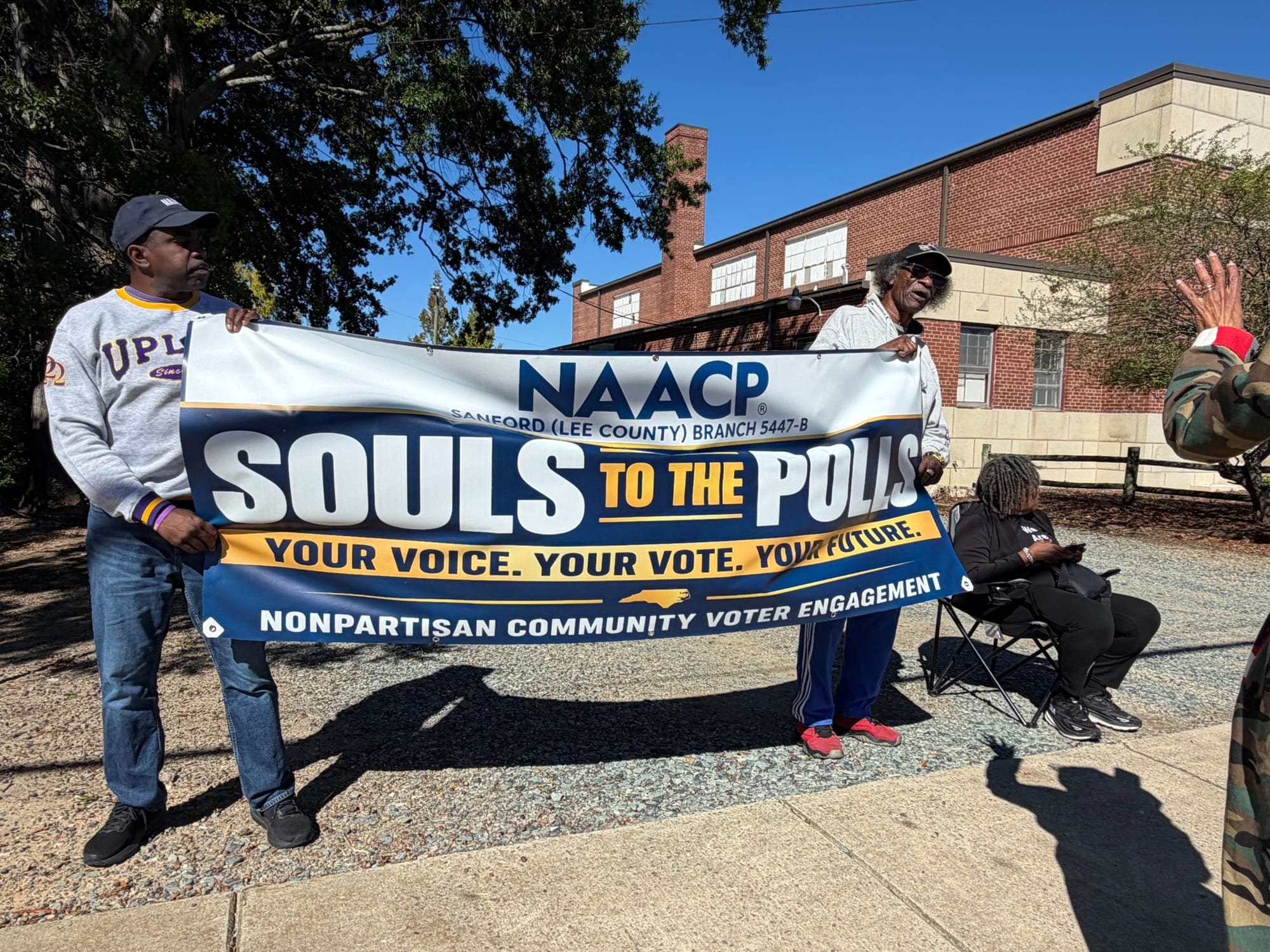
I spoke with a few voters that day, and while their reasons for voting on Sunday varied, they shared one goal. They wanted change in power, locally and nationally.
“I went the extra mile,” said Steve Schmidt, 69, speaking of Boyce, who is running specifically because of the data center that’s coming to his neighborhood in Lower Moncure. “Smith has been sketchy since I got here in the ‘90s,” he added. (He may have been referring to a few earlier incidents that drew public criticism. In 2014, a Rant editorial cited a Sanford Herald report on a meeting, during which Smith wondered why schools didn’t just save money by serving peanut butter and jelly sandwiches to students on subsidized lunch.)
Residents tired of not being heard by their leaders are taking to the physical and digital streets, including by creating social media videos together to support their preferred anti-data center candidates. Many in Lee County and surrounding areas keep pushing for a data center moratorium, even as the county government justifies its own inaction. While people see voting as a key way to contest the unrestricted expansion of data centers into their communities and corporations' unchecked takeover of their land and water, their fight continues far beyond the ballot box.
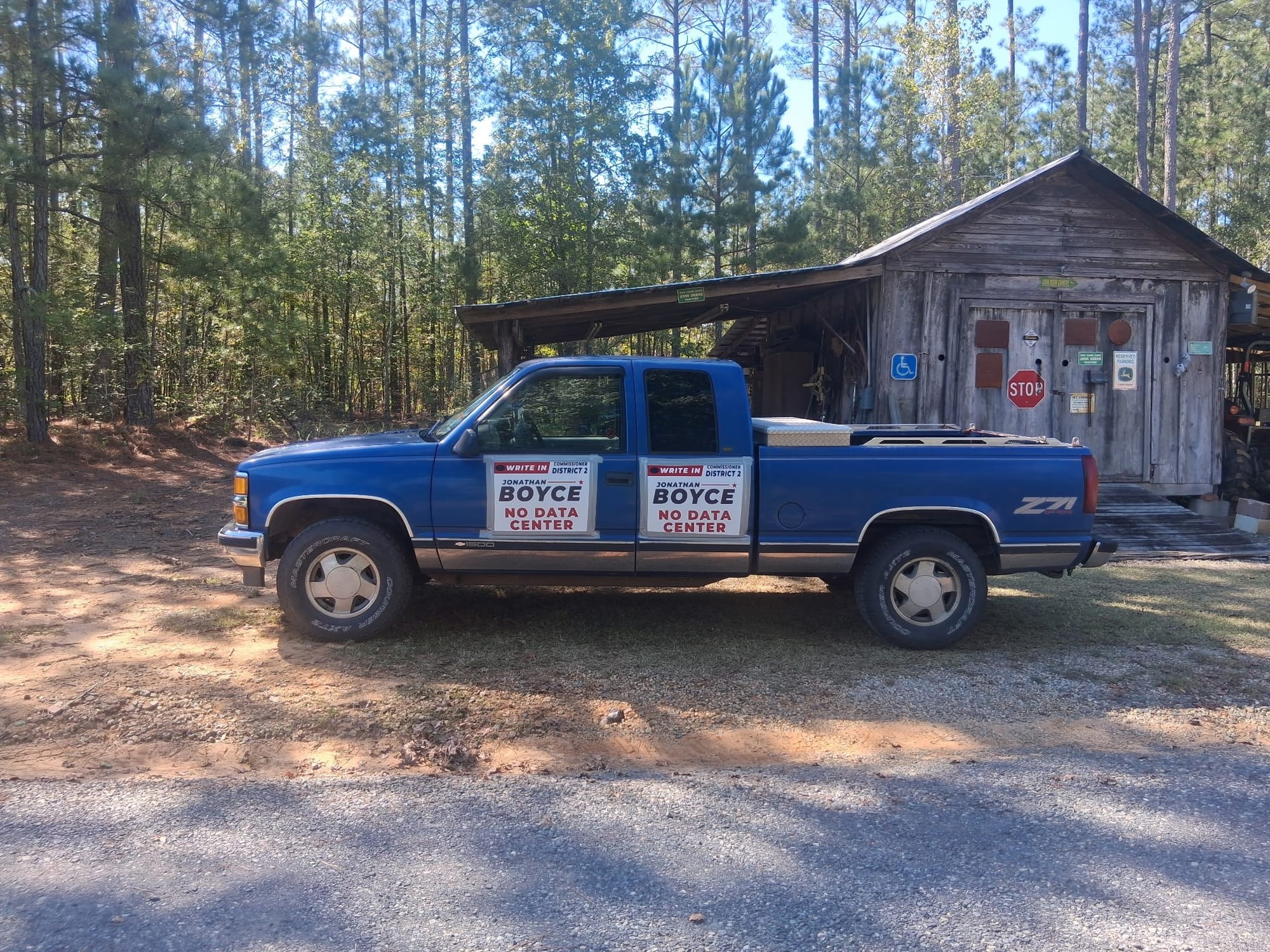
Mark Mansfield is still fighting, too. He sent me a picture of Boyce’s campaign signs taped to the side of his blue pickup truck.
“This is how a country boy campaigns on Lower Moncure Rd.”
Selected sources:
- AI Data Centers Are ‘Electricity-Eating Monsters’ Supercharging Climate Collapse
- The Data Center That Didn’t Exist
- County says data center project will proceed, releases project timeline – THE RANT
- The Terrible Combined With the Good - Inside Climate News
###
Diara J. Townes is an environmental engagement journalist in central North Carolina, covering local politics and community activism for her independent newsletter The Curious Scout.

- Data Center Coming to Your Neighborhood? See Where Your Candidates Stand. — Adam Mahoney, Capital B, October 27, 2026
This article introduces a dashboard from the NAACP and Tennessee-based black environmental organization Young, Gifted & Green that tracks election candidates’ stances on data centers and climate-related issues. The dashboard also offers a way for voters to request answers from candidates who have yet to express a stance. (Capital B is a Black-led, nonprofit local and national news organization. Donate to Capital B here.) … Recommended by Eesha
- Election Fraud Narratives in the 2026 Midterms — Disinfo Defense League Research Team, Media Democracy Fund, October 2026
DDL’s research team has released their latest analysis of prominently circulating online narratives about election integrity approaching next Tuesday. Their findings include confirmation of the prevalence of nativist rhetoric, as well as indications that localized, state-level claims appeal to be favored over national stories by those stoking election-related distrust and fear. (Media Democracy Fund’s Disinfo Defense League equips civil society partners to anticipate, understand and counter harmful narratives. Request to join here.) … Recommended by Eesha
- Paying Their Own Way: A Framework for Evaluating Data Center Electricity Agreements — Paul Donohoo-Vallett, Sara Enright, and Chris Harto; Consumer Reports; October 20, 2026
This new tool from Consumer Reports defines what it could look like for AI data centers to “pay their own way” and shows that even if data center developers cover all of the direct infrastructure costs, there are several indirect costs and other risks that will be passed on to local communities. The toolkit offers resources for local advocates, regulators, and policymakers to evaluate projects. (Consumer Reports is an independent, nonprofit consumer advocacy organization. Become a member here.) … Recommended by David
- AI Is Class Warfare. Workers Are Fighting Back. — Kelly Hayes (interviewer) and Alex Hanna, Truthout, October 29, 2026
Writer and sociologist Alex Hanna of the Distributed AI Research Institute discusses the real impacts that AI has on the lives of workers and how labor organizing is contesting both the power of tech corporations and the narratives of AI’s capabilities. (Truthout is an independent, nonprofit newsroom covering social justice. Support them here.) … Recommended by Eesha
- ICE Is Running One of the Largest Anti-Left Surveillance Operations in US History — Ali Winston, WIRED, October 28, 2026
This new investigation from WIRED details how ICE’s surveillance dragnet against activists rivals the size and scope of previous FBI and CIA operations during the Civil Rights Movement, various anti-war movements, and any other mass government surveillance operation in American history. (WIRED is a magazine that reports on, among other things, the past, present, and future of tech. Subscribe to their newsletters.) … Recommended by David

UPDATE: If you haven’t already, make sure to follow The Revival Lab on our social media accounts — we’re on Bluesky, Instagram, and YouTube!
- Thu., November 19, 2026: Research Tools for Organizers, Part 3: Nonprofits (virtual)Host: LittleSis
This training will discuss the role of nonprofits in elite power structures and where to find public information about nonprofit revenues, boards and staff, major contractors, grantees, and more.. See other upcoming LittleSis trainings here.
- Resource Spotlight: Submit Your Energy Bill to CR's Bill Decoder and Find Ways to SaveAuthors: Consumer ReportsPublished: October 21, 2026
To better understand how to tackle rapidly increasing energy bills, Consumer Reports recently launched the free Bill Decoder tool. The data will help CR experts track trends in rising energy costs and fight for fairer rates. By submitting a recent electricity bill, anyone can access information to help make sense of their complex monthly charges and get advice on trimming costs.

 The Revival Lab

 The Revival Lab
 The Revival Lab
Thank you for reading!