
Welcome to the Anti-Surveillance Era
By Dr. Reagan Nicole
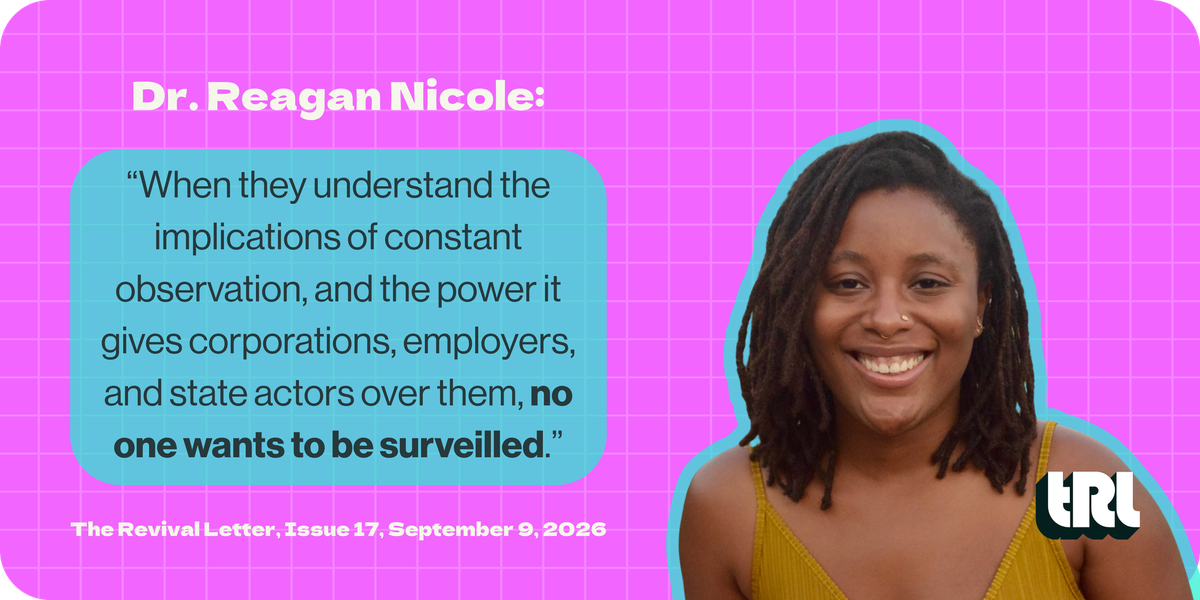
For years, tech companies have been creating their own market for biometric data capture, license plate scanners, and doorbell cameras. Unfortunately for those companies and their shareholders, the people have had enough. Based on the backlash to Meta’s "pervert glasses" and the destruction of Flock cameras across multiple cities, it seems that everyday Americans are officially in their anti-surveillance era.
You may have encountered the term “panopticon” used to describe the current surveillance landscape in the U.S. Outlets often use the term without providing a definition or discussing its origins. Michel Foucault’s Discipline and Punish: The Birth of the Prison, first published in 1975, is one of the foundational texts cited in discussions of surveillance as a tool of social control. In the book, Foucault describes Jeremy Bentham’s panopticon, a circular prison design with a central tower. The glass walls of the tower allow the guard to see into every cell. However, the incarcerated people cannot see into the tower to determine whether or not the guard is actually present; those confined to the cells can only see each other. The function of this design is self-discipline. Not only do the incarcerated people surveil each other, but they also act as if they are operating under the watchful eye of the guard at all times. No guard in the tower? No problem. The very possibility of surveillance is enough to alter behavior. But people have been making it known that they’re tired of being recorded, categorized, and, in the case of Flock cameras, subject to the fines and fees of the state.
Your generosity fuels our newsletter and research, strengthening the movement for media, tech, and information justice.
Donate now and join the revival today!
In July, media outlets published a flurry of articles about Taylor Swift’s wedding to Travis Kelce at Madison Square Garden (MSG). MSG owner James Dolan has faced criticism for the venue’s use of facial recognition technology and the targeting and tracking of guests. He has insisted that the tech is necessary to track his adversaries and unruly guests, as well as to “prevent terrorism.”[1] Swift and Kelce’s guests, unlike members of the general public who attend sporting events and concerts at the venue, were not subject to data collection. MSG disabling the cameras for Swift’s wedding prompted questions about how the wealthy elite can buy their way out of surveillance while the masses cannot.
LGBTQ+ people are especially vulnerable to surveillance. One piece in a WIRED series on surveillance at MSG, “The Shocking Secrets of Madison Square Garden’s Surveillance Machine,” was especially troubling because of its implications for the LGBTQ+ community. Investigative journalists Noah Shachtman and Robert Silverman reported that:
- MSG’s vast network of cameras and facial recognition technology allow the venue’s security team to monitor guests down to the second.
- An MSG database tracked and categorized celebrities based on race, gender, and sexual orientation. Celebrities were also assigned “risk scores.”
- MSG security chief John Eversole frequently made disparaging remarks about a transgender woman and tracked her movements within MSG down to the second before ultimately banning her from the venue.
Dolan responded by filing a lawsuit against WIRED for its reporting. But MSG isn’t the only venue that was making data points of its queer patrons.
On June 10, The San Francisco Gazetteer published an article entitled “Why do these Castro gay bars have TSA-style face scanners?” Reporter Cydney Hayes investigated three bars in San Francisco’s Castro neighborhood that had installed facial recognition kiosks to collect customers’ names, addresses, and genders, and to store the information of patrons committing misdeeds while at the venues. The Patronscan Guard+ machines were in use at Mix, Badlands, and Toad Hall. When the bars’ managers failed to respond to Hayes’s request for comment, Hayes visited Mix and noted that the bouncer reviewing IDs did not verbally inform patrons that they were being photographed. In fact, when Hayes asked if they would be photographed, the guard informed them that the camera had already taken their picture. The only notice was a small plaque posted to the kiosk below eye-level. According to Hayes, the Mix bouncer explained that patron data are stored on the Patronscan platform for 30 days and then deleted “unless a patron has been flagged for bad behavior, ‘like fighting or stealing’ in which case it’s stored indefinitely.”
The reporting in the San Francisco Gazetteer was picked up by national news outlets and led to a boycott campaign against the bars initiated by Fight for the Future, a non-profit organization that champions digital rights. The organization launched a petition to remove the facial recognition kiosks and called on all artists, including drag performers and musicians, to refuse to perform at venues using facial recognition technology or AI to surveil patrons. By August 15, all three bars had agreed to pause the use of facial recognition technology at their venues.
On the consumer technology front, privacy advocates are also speaking out against Meta’s plans to incorporate facial recognition technology into the company’s AI smart glasses. A report by 404 Media brought to light the fact that Meta has filed a patent for its AI smart glasses that would add facial recognition to identify people in frame and automatically create video clips and highlight reels of those individuals without prompting. Meta has not officially announced when it might roll out this feature, known internally as “Name Tag,” but a broad coalition of more than 70 organizations, including civil liberties, domestic violence, reproductive rights, LGBTQ+, labor, and immigrant advocacy groups, is already mobilizing against it. Back in April, the coalition, which includes the American Civil Liberties Union (ACLU) and Fight for the Future, demanded that Meta jettison plans to add facial recognition to its smart glasses, expressing concerns that the feature “would hand stalkers, abusers, and federal agents the ability to silently identify strangers in public.” The addition of facial recognition technology would only add to the wearables’ already controversial reputation.
In February, Swedish outlet Svenska Dagbladet reported that Kenyan workers were subcontracted through a company called Sama to sort through and annotate the content recorded by the glasses, including sensitive or private content such as bank cards, bathroom trips, and sexual encounters, so it could be put into Meta’s AI models. Per the article, there is a “hidden stream of privacy-sensitive data that is fed straight into the tech giant’s system,” and the Kenyan people who have been hired to sort through the data said they felt uncomfortable going to work. The data annotators, as they are called, explained that questioning the work would get them fired. Years of reports and testimonials have outlined the traumatizing, underpaid, and oppressive workplace experiences of data annotators working for Meta and other companies, as well as how workers have launched or joined efforts to improve their conditions. AI technologies like Meta Glasses depend on the invisibilized labor that these workers and other workers in the global South perform, often at great risk to their mental health and for little pay.
The fight against surveillance in general and Meta Glasses in particular is a worker issue in more ways than one. In an article for The Verge, “Meta Glasses Are a Workplace Menace,” journalist Mia Sato tells the story of a Target employee who was harassed by two men using Meta Glasses to record themselves repeatedly asking about the price of an item and misgendering the worker. Retail and service workers, who are already subject to workplace surveillance by their employers, are now finding themselves being recorded by customers, most of whom are men. Sato writes, “Many of the encounters filmed using Meta Glasses are explicitly gendered, like a genre of videos where men approach women with pickup lines and make content out of the encounter.” The encounters, which the men refer to as “pranks,” are then posted on social media without the knowledge or consent of those filmed, as was the case with the Target employee. Although Instagram’s CEO Adam Mosseri announced that the platform would take down Meta Glasses content that included harassment, new videos are popping up each day.
One venue has responded to the rise of Meta Glasses by outright banning them. Popular New York City music venue and nightclub Basement recently announced on X.com that their policy prohibiting photos and videos, which exists to "protect the privacy, safety, and freedom of everyone” on the dance floor, extends to “devices that allow discreet recording.” The post went on to state that “anyone bringing smart glasses into the venue, whether wearing them or carrying them in a bag, will be asked to leave and may be permanently banned.” One can only hope that other venues follow Basement’s example. After all, who wants to be surveilled in the club? In fact, who wants to be surveilled at the grocery store, or while driving?
The answer is “no one.” When they understand the implications of constant observation and the power it gives corporations, employers, and state actors over them, no one wants to be surveilled. That’s why people across the country are taking action in a variety of ways including, but not limited to, destroying license plate readers created by the Atlanta-based surveillance startup Flock. Reports of smashed Flock cameras have popped up in California, Connecticut, Illinois, Oregon, and Virginia, and those who have been arrested for destroying the cameras have received ample support from the general public. Other advocates are taking the time to teach people how to prevent their license plates from being scanned.
The resistance is working. On August 31, the Florida Department of Transportation announced that it revoked permits for license plate readers, like Flock cameras, on state highways. In a memo, Florida’s Assistant Secretary of Transportation, Will Watts wrote, “...the recent exponential increase in deployments along our roadways, coupled with concerning reports of misuse, data privacy concerns, and surveillance schemes merit immediate action to preserve Floridians' sovereignty and quality of life.” It’s not farfetched to think that other states may soon follow Florida’s lead and ban license plate readers along state highways. Surveillance may be more prevalent than ever, but we are not confined to the panopticon. Everyday individuals are making demands, petitioning, boycotting, and sabotaging surveillance tools. The public is putting private companies and state actors on notice and declaring that each of us has an inalienable right to privacy.
Notes:
- The NYPD does not share information with MSG, and a plan (made after Dolan’s statement about terrorism) to incorporate the FBI most-wanted list into the venue’s facial recognition database “fizzled out.”
###
Dr. Reagan Nicole is a racial justice researcher and scholar of Communication. She is currently teaching at Stanford.

- Teens Have Always Been on the Front Lines of the Labor Movement — Kim Kelly, Teen Vogue, August 18, 2026
This piece looks back at more than a century of labor organizing in the U.S. and shows how young workers have always been at the forefront. (Teen Vogue covers politics and culture for young people. Sign up for their newsletter.) … Recommended by David.
- Louise Vincent built the collective power of drug users. A year after her death, the movement she sparked struggles to pick up the pieces. — Aviva Stahl, Prism, August 31, 2026
This story shares how Louise Vincent worked to build the collective power of drug users to demand essential human rights. It focuses on her incredible work and the fleeting nature of momentum after her passing. (Prism is an independent, nonprofit news outlet led by journalists of color. Donate to Prism) … Recommended by David.
- The county prosecutors who became ICE informants AND Illinois promised to protect immigrants. Local officials helped deport them anyway. — Aura Bogado, Injustice Watch, August 25, 2026
A pair of deeply reported investigations that detail the extent to which local officials and courts have been collaborating with ICE in a state that pledged to protect immigrants from Trump’s crackdown. (Injustice Watch is a nonprofit newsroom that produces human-centered investigations that lead to impact. Donate to Injustice Watch) … Recommended by David.
- Back to the Bund — Samuel Hayim Brody, Jewish Currents, August 17, 2026
This review looks at Molly Crabapple’s new book, Here Where We Live is Our Country, which details the raise and fall of the Jewish Labour Bund in the early 20th century. What follows is a thoughtful discussion of what the Bund hoped to accomplish and whether there are any lessons we can apply to our time. (Jewish Currents is a nonprofit magazine dedicated to Jewish journalism, analysis, arts, and culture. Subscribe here.) … Recommended by David.
- Sign of the Times: An Account of the First Tech Workers’ Strike — Various Contributors, Long-Haul, Summer 2026
This selection of reflections provides a timeline of the strategy and tactics of the 2024 New York Times Tech Guild strike, as well as the implications of the resulting collective bargaining agreement. This type of movement evaluation can be an invaluable resource to future organizing efforts. (Long-Haul is a quarterly magazine of worker writing about culture and organization. Subscribe here.) … Recommended by Eesha.

This week, we’re celebrating some anniversaries! Check out this list of a few albums and mixtapes turning ten in 2026, reflect with us on the cultural moment they capture, and maybe go to one of the several anniversary tour dates with artists commemorating their 2016 work.
- Chance the Rapper: Coloring Book (hip hop, gospel, pop)
- Frank Ocean: Blonde (R&B, psychedelic pop)
- Jamila Woods: HEAVN (R&B, neo-soul)
- Mitski: Puberty 2 (indie rock, alternative)
- Michael Kiwanuka: Love & Hate (soul)
- Beyoncé: Lemonade (R&B, pop)
- Kendrick Lamar: untitled unmastered (hip hop)
- John Legend: Darkness & Light (R&B, soul, pop)
- Donald Glover: “Awaken, My Love!” (R&B, funk, soul)

UPDATE: If you haven’t already, make sure to follow The Revival Lab on our social media accounts — we’re on Bluesky, Instagram, and YouTube!
- Thu., September 17, 2026: Research Tools for Organizers, Part 1: Intro to Power Research (virtual)
Host: LittleSis
This training will explore how to identify key networks of corporate power that uphold and profit from systemic injustices, as well as how research into these networks can be used to challenge their power. See other upcoming LittleSis trainings here.
- Sat., September 19, 2026: Fighting TechnoFascism: Power, Surveillance, and Resistance (in-person: Chicago)
Hosts: MediaJustice and Mijente
A one-day convening of nationwide organizers fighting energy-sucking data centers, the surveillance state powered by Flock, and tech-enabled mass deportations and murders.
- Resource Spotlight: Whole Worker Surveillance
Stevie Glaberson, Emily Tucker, & Tina Solki for Georgetown Privacy Center
This zine presents the center's research on workplace surveillance and stories from Whole Foods and Amazon workers in particular in an engaging way, coupled with resources for workers interested in fighting back.
- Resource Spotlight: BET Archive
Compiled by: Wayback Machine & Internet Archive
Last week, Black Entertainment Television (BET) removed all digital articles from its website in a move signaling the organization's prioritization of video and multimedia content. In response, the Internet Archive shared this new explorer, created with the Wayback Machine, to view the 199,000 BET articles the archive has saved over the years.

 The Revival Lab
 The Revival Lab
 The Revival Lab
Thank you for reading!