
The Gift of Second Sight
A conversation with Dr. Sarah J. Jackson
We had the chance to speak with Dr. Sarah J. Jackson about her newest book A Second Sight: How the Wonder and Vision of Black Mediamakers Push America Toward Freedom, available now from HarperCollins. We hope it is as engaging and thought-provoking for you as it was for us!
This interview has been edited for length and clarity.
Eesha Ramanujam: Could you speak a little bit about how you define media, since that's pretty foundational to how you approach the book?
Dr. Sarah J. Jackson: I define media broadly, and I think that part comes from being a scholar of media. There's this common experience where when you say that you're studying media, people immediately understand the news and journalism. Sometimes they understand that that means film and television and radio, but they're almost always thinking about contemporary forms of media using some form of modern technology. But for the book, I include slave narratives, pamphlets that were published by free Black civic associations, early forms of photography that Black people use to recast themselves as citizens. I include books — people forget that books are a form of media. The publishing industry is a media industry! I write about some speculative fiction as well.
It's easy to forget when we talk about media that at different periods of time, the technologies were different. The mass circulation of ideas, of stories, and of images, might have been done through a different technology, but those were the things that enabled mediation. I really, really worked to define media broadly because I think it's important to be specific about what we mean and put it in its larger historical, cultural, and sociopolitical arc.
Your generosity fuels our newsletter and research, strengthening the movement for media, tech, and information justice.
Donate now and join the revival today!
ER: How did you know that you wanted to address W.E.B. Du Bois's “second sight” concept in this book? Was it a way of making sense of what you already knew you wanted to talk about as a scholar and writer, or did the concept itself spark the ideas for you?
SJJ: There’s two strands to answer this question. One is that, like many people who have thought and studied and read a lot about race in America, I've always understood Du Bois as being a formative thinker, scholar, activist, and — because of the field that I work in — media maker. You know, he edited The Crisis magazine for 25 years. He wrote and produced a lot of other kinds of media, including some speculative fiction. He was really engaged in what he called positive propaganda, to try to combat the white supremacist propaganda that was in the mainstream in the US. And I had always found it fascinating that people took the concept of “double consciousness” from The Souls of Black Folk, which, of course, is a formative and important concept in sociology, psychology, etc., about accurately describing the feeling of oppression and marginalization and exclusion that comes with being Black in America.
Du Bois describes the veil of being self-aware, but understanding that you're being obscured by the larger perspective. He says that this curse that he calls double consciousness comes with the gift of second sight. He doesn't expound as much on the concept in Souls, although he does come back to it in some of his later work. But I always wondered about how the focus in the intellectual tradition has been on double consciousness, and the concept of second sight has sort of been evacuated from it.
For anyone who has studied feminist history or feminist scholarship, Du Bois was theorizing what people like bell hooks and Patricia Hill Collins would call the “outsider within” standpoint — this idea that you have a clearer picture, a more critical vision of something, if you're standing on the outside looking into it. This is a profound gift, he says, for not just critique, but for imagination. I had always been fascinated by why people didn't necessarily think as much about second sight as they did double consciousness, because it feels like a paired concept to me. And that's from my background in African-American studies and critical studies.
On the other side of my training, in the field of communication — political communication, media sociology, and all these other maybe more social scientific approaches to studying communication — there's a tendency, just like in many other fields, to center white European enlightenment traditions. [Jürgen] Habermas, [John] Dewey, and many other folks in that kind of tradition loom large in theories of democracy. And as a result, what that tradition has called counter publics, the folks who weren't at the center but who were making dominant culture, are studied and theorized under the assumption that they were at the margins. And part of what I really wanted to acknowledge is that, while these counter publics might be marginalized, the reason that their work, their ideas, their media, and so forth are worth studying is because they've actually succeeded in fundamentally shifting the center. They actually have been a compelling and primary force in political theory, in political philosophy, in the development of democratic ideas. They haven't been “untold” stories or “marginal” stories. They've been stories that presidents of the United States had to respond to. Thomas Jefferson had to respond to Benjamin Banneker. George Washington had to respond to Phillis Wheatley. If these stories were so much at the margins that no one was paying attention, there'd be no reason to respond to them.
So part of what I wanted to do is bring these two lineages together to highlight the clarity of the second sight, and what Black media makers and storytellers from the “outsider within” perspective have historically done with it.
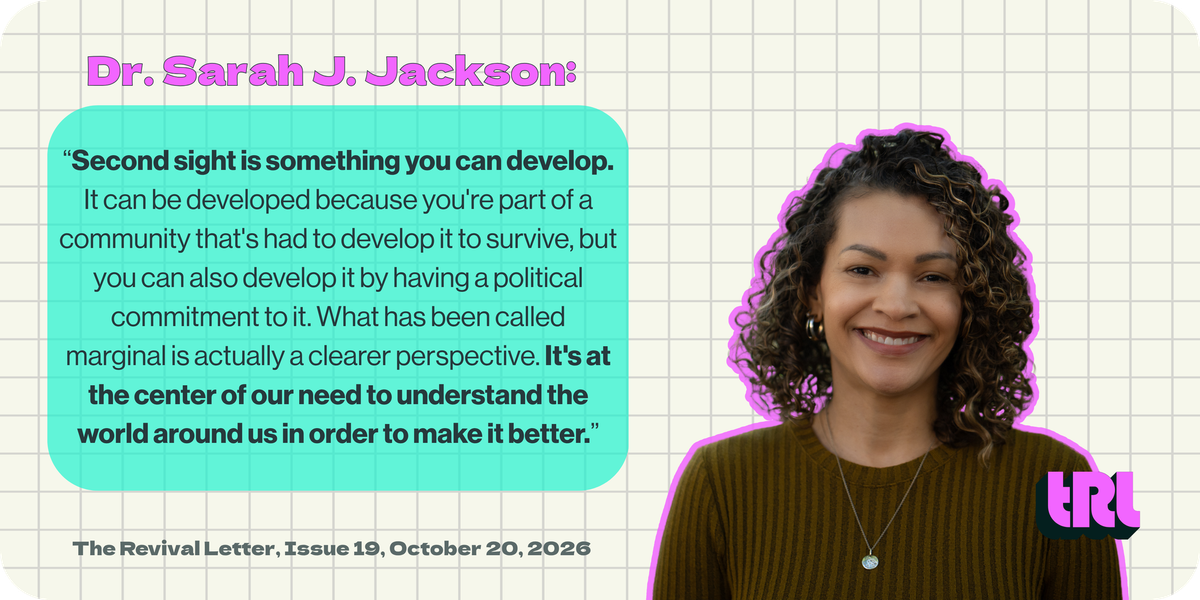
Second sight is something you can develop. It can be developed because you're part of a community that's had to develop it to survive, but you can also develop it by having a political commitment to it. What has been called marginal is actually a clearer perspective. It's at the center of our need to understand the world around us in order to make it better.
ER: You have talked about moments of opening and moments of foreclosure, and where you saw the writing and eventual publication of your book playing out in that. What you're describing in terms of these different thinkers and organizers engaging with each other speaks to this element of strategic timing, to the importance of interpreting why they were able to shift the center. I wonder, what does it mean to you to be prepared as a scholar with a political commitment for moments of opening and moments of foreclosure in that tradition?
SJJ: Being prepared offers a kind of clarity. It helps offer, both in scholarship and in organizing, a clear view of why we do particular types of work and what its value is. Throughout history, there are these fundamental, remarkable revolutionary ruptures in how people think. What people can imagine for themselves, for one another, and for their society shifts the ground under us in terms of expanding rights, or expanding demands, or expanding the vision for the world we want to live in. And every single time this happens, there is a backlash. There is a foreclosure. Whether it's the backlash to Reconstruction, which was the onset of a very long period of Jim Crow in America, or the backlash to the civil rights movement, which was Reaganism. Whether it's the backlash to the Black Lives Matter movement, which we are living through now.
If you start to see and understand these patterns, then when the backlash starts, you're not moving from a place of shock. You can look to history and see.
You can look at the lessons from McCarthyism, for example, which was a period of backlash in this country to the expansion of anti-capitalist ideas and laborers having power. The question of whether you should testify or not is something I've been thinking about a lot. Being at a university in the past few years as university presidents have been called to testify, you can't but help think about what a mistake it was for people to testify in the McCarthy hearings.
If you know these histories, then you already have a ground, right? The historical moments are different. The conjunctures are different. Power is moving differently in some ways. But you have a ground to start from when theorizing and organizing, if you understand patterns. And you can also try to imagine how to avoid the backlash the next time. Because the ultimate goal is to have that ground-shaking revolutionary rupture and have it stick.
Every time, the backlash looks different, and the backlash is evasive, because power and hegemony are evasive, and they move, and they adjust. We have ancestors who built tools for us to be able to respond. And so that's why I think situating this as a pattern and understanding the history is important.
ER: Absolutely. Digging into this idea of the pattern, you alluded to how there’s a temptation to use the idea of “now more than ever” as a way to facilitate urgency and momentum. But that also stands in direct tension with the fact that there is precedent for a lot of this, even if there are pieces of it that feel unprecedented. You write in the book not just about this broad pattern of history, but also about patterns specifically as they pertain to media — what is different or distinct about media now and what hasn't changed. How are you thinking about when it's useful to offer context that makes things seem precedented versus identifying the distinctions of now?
SJJ: I think about things through an organizing framework, even though I'm an academic, because I study and think about organizers and what they have and haven't been able to accomplish in our political system. There's a pragmatism to being committed to political and social change. And with that pragmatism comes a profoundly urgent optimism — that it is possible to change the present, that we can change people's material conditions now.
But the nuance in realism is really important. And we know this from the people that came before us, that many people were fighting knowing that they wouldn't see the changes they were fighting for themselves. They still believed that those changes were worthwhile. Many enslaved people rose up and engaged in various forms of rebellion, big and small, with a very clear understanding that it would likely result in the ending of their lives, because it was worth the chance to experience freedom, but it was also, more importantly, worth the chance for everybody to experience freedom. We want future generations to live in a world that's not ravaged by climate catastrophe and war and inequality. It's actually a form of optimism to say, “I believe that world can exist even if it can’t exist for me.”
You ask specifically about the media. The conditions of the media in the contemporary era, the billionaire ownership, the consolidation, and the technocratic and technofascist capture of our media — these are unprecedented conditions for our media system. We have never been in a moment like this where such a specific type of person has captured the media so completely. But we have precedents if you look at the power of steel magnates at a particular period of American history, and the control that they had over laborers and everyday people's lives. You could look at Henry Ford's fantasies of controlling every waking minute of his laborers' lives down to where and how they lived. There are precedents of these kinds of people and personalities, this kind of thinking, and this kind of power that don't align one-to-one, but that can teach us lessons for the contemporary media system. And we know from those lessons that it has been people power, community-controlled media and resources, and collective struggle that have shifted or challenged those forms of power.
It's not a question of flattening and saying the past is the present and nothing has changed. I mean, obviously that's not true. Things have changed. The country's changed. The media has changed, in terms of its infrastructure and its economics and its technologies. Racial politics in this country have changed, right? I totally reject the sort of Afropessimism that suggests that it's all hopeless, that we can’t escape this. But a real reckoning requires what Frederick Douglass said: we need thunder and lightning and fire and rupture, not reform.
ER: Definitely. You just mentioned Douglass, and in the book you discuss this precedent of disagreements and discourse that happened between some familiar historical figures that studied and worked in community with each other, including Douglass, Du Bois, and Ida B. Wells. Could you share a bit about how disagreement and discourse with your peers and communities show up in your own process as a scholar with a political commitment, and how it has been challenging and/or productive?
SJJ: Even as this book tour has been happening! I love this question because I think this is really important. In some part, thanks to the internet, we are living in an era in which disagreement is kind of overly proscribed. If you disagree with somebody, they're a bad person, or if somebody disagrees with you, they're trying to cancel you or whatever. And this is another case where if you have a political commitment, you have to have nuance.
Frederick Douglass and Ida B. Wells, people of a different generation whose lives and paths crossed — young Wells and elder Douglass, it's incredible to imagine, right? — disagreed on the strategies for fighting lynching and for making a case for Black citizenship. At this period in time, Douglass is more of the moderate, and Wells is more of the radical. Although, of course, when he was young, Douglass was the radical. The thing that they share is a commitment to the freedom of Black people, and to the expansion of democracy, and to the bettering of the country where they and the people they love have to live. And they collaborate, despite some of the methodological disagreements they have about how to address these issues, on this remarkable document for the Columbian Exposition in Chicago.
They help to circulate this, and in doing so, they actually help to cohere an intergenerational group of Black storytellers, media makers, and musicians who all are there in Chicago. It doesn't mean that they didn't argue — I don’t want to assume Frederick Douglass and Ida B. Wells drank, but I imagine them drinking bourbon and arguing about “Colored American Day” at the fair, because they disagreed on whether they should attend or not. And that is very different from Du Bois and Booker T. Washington, who really disliked each other as people, and intensely disagreed politically. They both were also making efforts towards Black freedom.
Regarding how I experience this, I've had conversations with people about this book who think I’m giving these founding ideals of life, liberty, and the pursuit of happiness too much credit. The founders didn't want this for us, and they were corrupt from the beginning, etc. And I know the founders didn't want this for us, but that is part of the project that I’m chasing. We can talk through this because we're engaged in the same project of trying to expand democracy in our work.
Or there's this way that traditional media histories, including Black media histories, have erased women, because traditional definitions of media making and public engagement have sort of overindexed on the press. There are cases of women who owned printing presses and were publishers. Ida B. Wells is, of course, one, but also Charlotta Bass, who I discuss my book, was a Los Angeles-based journalist and newspaper publisher who ran for vice president. But for the most part, the press was men. I made the choice to have a more expansive definition of media, because then I could talk about Anna Julia Cooper. Then I could talk about Octavia Butler. Then I could talk about Daughters of the Dust, and these other important media texts.
But I am open to critique around these ideas, and in fact, I tell my students all the time that if we're engaged in community, whether that community is formed around an intellectual project and the expansion of knowledge, or whether that community is concerned with the expansion of rights, critique is love. I want them to understand that when I critique them and give them feedback, I'm actually doing so because I want them to succeed, and I want to make them better. I want them to see that in class when we critique theorists, whether that theorist is Habermas or Du Bois, whether that theorist is Dewey or Douglass, that when we're critiquing, we're not throwing out. We're saying that we respect this person's ideas, that they're worthy of our engagement.
I was a debate kid and I was trained to see a good argument as fun. So as long as people are entering with good intentions, and as long as there's a collectively-understood goal, we're expanding knowledge, or we're expanding rights, or we're making things. And if we disagree on the means or the terms or the definitions or whatever, then let's fight it out. This is how anything gets done in a democratic public sphere. Deliberation is fundamental. So I welcome it, and I have organized a couple “author-meets-critics” forums for my book because I want to hear what people will say. People have been very generous and said very nice things about the book, but I do want to hear how it's landing for different fields and in different spaces.
ER: To close us out, there's this throughline of this gift of second sight that you’re describing playing out in your own analysis. On page 153, you wrote about Black storytellers pursuing “their own creative happiness—to tell stories that reflect their truths, their communities, and their dreams.” So I wanted to ask you, what does it mean to you, as a Black media maker, to pursue your own creative happiness?
SJJ: This is a deep question. Look, I'm an academic, and if I think about the knowledge I'm producing as media, it usually comes out in books or is published or circulated to a limited audience in academic journals. This is a catch-22 for a lot of academics who might also be thinking about creative freedom, because there are certain norms and conventions for publishing, for getting a book contract, for reviewers to publish something. And there are differences between the norms and conventions for publishing the academic books I've written and publishing this book with the trade press. It wasn't as if all of a sudden I was free to do whatever I wanted. There are different boundaries.
In some ways, I'm doing this for my job. Black media makers are paying their bills, they're telling stories that they think are important, and they're doing it within constraints and conventions while also pushing against them. That is what I've always tried to do in my work.
For example, when we started writing Hashtag Activism, Moya [Bailey], Brooke [Foucault Welles], and I were all junior scholars. None of us had tenure. People were telling us, you can't co-author a book, you have to write a monograph, people won't understand who to give credit to and how to give credit, it's not worth your time, focus on your own work. And we were like, this is our own work. We are a community. We're friends. We each have our own set of expertise, and we know that we can best do this work with all three of us contributing to it. What we produce will be better and more authentic to what we believe is necessary to answer these questions if all three of us contribute to it. We went against the advice and wrote a co-authored book, and it felt like a small part of freedom.
We also asked some of the organizers and some of the hashtag originators who we study in the book to write small pieces that we added into the book as part of the narrative. We applied for a small grant, and we paid them to do that. And again, you often don't see this in research, especially social media research in that period. People were studying users of social media as objects, as subjects, but not as agents who could tell their own stories.
We still had to abide by the conventions of academic book publishing, but in some ways, these two examples represent us taking back some agency from those conventions, taking some risks. And by the way, people loved that book. It was received well and highly cited. We're all now more established, tenured faculty at various institutions. And so it worked out fine, that pursuit of our own freedom.
Then I decided I wanted to write a trade book for people who care about these issues, who aren't just academics, who don't know public sphere theory. So I had to constrain this book in ways that were about meeting the needs of the mainstream publishing industry, which also cares about marketing and sales, which, by the way, academic publishing doesn't care about at all. Reaching a different audience was, for me, an act of freedom. Being able to do something that had more public impact was part of my pursuit of happiness.
There isn’t always a pure way to just be individually engaged in a free project. There could be some creatives that do, I imagine, but even somebody like Octavia Butler or Julie Dash — they still had to get a book contract, they still had to get funding for the film, you know? There's always some constraint. And yet, look at the remarkable ways that they were able to engage their own creative visions. There is freedom even when you maneuver within power, when you use it to your own ends.
###
Dr. Sarah J. Jackson is an Associate Professor and Co-Director of the Media, Inequality & Change Center at the University of Pennsylvania.
Eesha Ramanujam is the Research Director at the Revival Lab.
Additional links from TRL staff:
- How Black Mediamakers Are Retelling America’s Story — Perry Bacon, Right Now on The New Republic, June 18, 2026
- Penn professor's new book explores impact of Black storytellers on American culture — Molly McVety, Philly Voice, May 26, 2026
- A Second Sight - A conversation with Sarah J. Jackson and Clint Smith (video) — New America, June 18, 2026

- Too Long Others Have Spoken For Us — Joseph Torres, Pressing Issues, October 6, 2026
In this transcript of a recent speech, Joseph Torres marks the 200th anniversary of the founding of the Black press in New York City by detailing the long struggle of journalists of color and their work to democratize our society. (Pressing Issues is the free newsletter from Free Press, an advocacy organization working to build media and tech systems that actually serve the public. Subscribe today.) … Recommended by David
- The Tech Oligarchs Have Captured Washington, Now They’re Pivoting to the States — Jai Dulani, Truthout, October 14, 2026
MediaJustice’s Jai Dulani breaks down how AI and crypto use political spending to shape policy and avoid accountability. This year, they’re pouring more money into state and local races. (Truthout is an independent, nonprofit news organization covering social justice. Support their work.) … Recommended by David
- ‘I’m Not Going to Have Blood on My Hands’ — Nicole Noren (interviewed by Danny Funt), Columbia Journalism Review, October 14, 2026
After an award-winning 24 years at ESPN, journalist Nicole Noren left the company, citing its recent integration of advertising and partnerships with gambling apps. This conversation includes Noren’s experiences with gambling addiction in her family, as well as some concerns about the risks of culturally embracing these platforms. (Columbia Journalism Review provides analysis on the world of journalism and the media industry. Become a member here.) … Recommended by Eesha
- Brazilian Crossroads — Marcos Nobre (interviewed by Daniel Pavan), Phenomenal World, October 10, 2026
This interview breaks down the political and economic realities that are shaping Brazil’s election, where incumbent Luiz Inacio Lula da Silva is in a runoff with far-right Senator Flavio Bolsonaro. Of particular interest is Nobre’s discussion of what he calls the “Bolsonarist Digital Party.” (Phenomenal World is an independent nonprofit project that publishes political economy analysis from around the world. Support them here.) … Recommended by David
- Remembering the Latina DJs who shaped LA’s house scene in the ’90s (embedded Instagram video) — Rigo Bonilla Jr., Los Angeles Public Press, October 14, 2026
Made to Move LA gives Angelenos a chance to experience the rarest underground cuts while also being a part of a collective memory project dedicated to the history of the women who shaped an influential music scene: Los Angeles Hard House. (Los Angeles Public Press is a local newsletter documenting stories from around LA. Subscribe today.) … Recommended by David

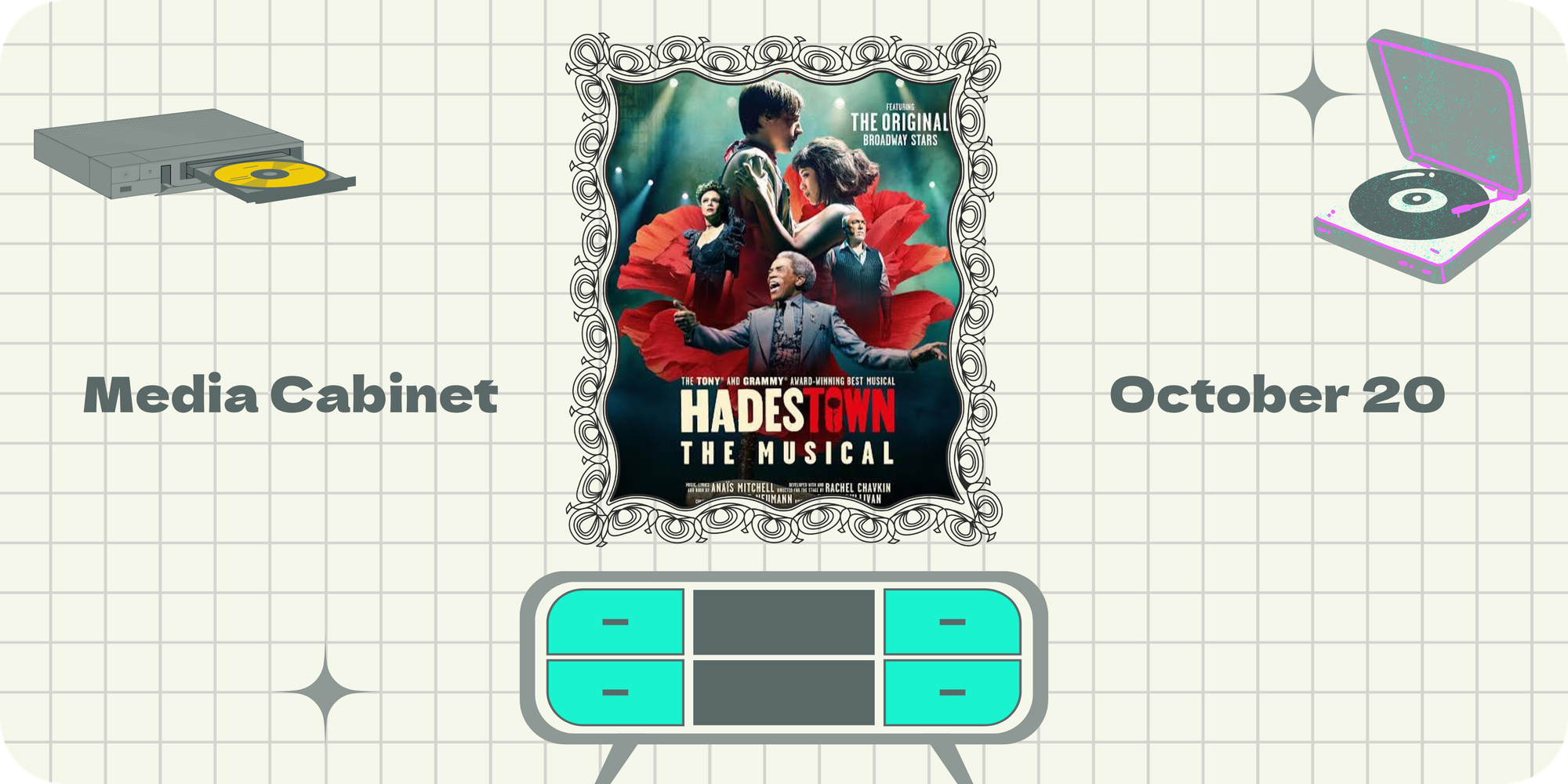
Hadestown: The Musical (2026)
The award-winning musical Hadestown is one of the latest onstage productions to have a professionally-shot live performance, or “proshot,” released to movie theaters. The folk opera retells the myth of Orpheus and Eurydice with elements of contemporary social, economic, and political themes. The filmed version featured cast members from both the original Broadway and West End productions, including the celebrated performer André de Shields. Hadestown: The Musical was so popular that the one-week run in theaters was extended, allowing it to become the highest-grossing proshot of all time. This type of recording and release has been enthusiastically endorsed by people who seek to make theatrical performances from Broadway to the West End more accessible to a wider audience. You can now view this proshot at home on demand through Letterboxd Video.

UPDATE: If you haven’t already, make sure to follow The Revival Lab on our social media accounts — we’re on Bluesky, Instagram, and YouTube!
- Thu., October 22, 2026: The Edge Dialogues (virtual)
Host: Tech Policy Press and the Privacy Center at Georgetown Law
This new bimonthly webinar series will explore fundamental issues and ideas upstream of tech policy. This opening installment will feature special guest Dr. Alondra Nelson, Harold F. Linder Chair at the Institute for Advanced Study.
- Thu., October 22, 2026: Research Tools for Organizers, Part 2: The Corporation (virtual)
Host: LittleSis
This training will demonstrate how to use the Securities and Exchange Commission’s EDGAR database to find strategic information in public filings from corporations and how to use that information in corporate campaigns. See other upcoming LittleSis trainings here.
- Resource Spotlight: AI Risk Assessment: ChatGPT for Teens
Authors: Common Sense Media
Published: October 7, 2026
Researchers from Common Sense Media tested one of OpenAI’s newest products, ChatGPT for Teens. After testing more than 4,000 prompts, the testers rated it an Unacceptable Risk for all children under 18. “ChatGPT for Teens could give parents false confidence in guardrails that frequently don’t work.” Subscribe to see more from Common Sense Media.

 The Revival Lab
 The Revival Lab
 The Revival Lab
Thank you for reading!