
Fighting Technofascism
Reflections from a convening hosted by MediaJustice & Mijente

On a gray Saturday morning in September, MediaJustice and Mijente kicked off a full-day event on “Fighting Technofascism,” convening organizers, advocates, elected leaders, and scholars for a series of panels and strategy sessions about organizing in 2026’s particular political terrain. Between spirited lunch conversations and (at least on our end) feverish note-taking; panelist stories and interactive discussion blocks; and revisiting history and imagining futures, attendees were invited to assess and start building shared agendas for political mobilization.
In that hall, just as in several other spaces The Revival Lab has been able to participate in over the past few months, the overwhelming feeling was one of momentum. It was as if the air was almost shimmering with the participants’ restlessness to get started. Audiences cheered speakers’ or panelists’ most scornful indictments of billionaire tech evangelists and unprincipled politicians; attendees rushed to introduce themselves to one another, identifying ways to collaborate or stay engaged with one another until an opportunity presented itself. Speakers may have detailed the grim, sobering realities of corporate consolidation, accelerating inequality, mounting surveillance, and extractive environmental degradation. But when people got in the room together, what lingered was not merely the story of the harm, but rather the eagerness for action.
Your generosity fuels our newsletter and research, strengthening the movement for media, tech, and information justice.
Donate now and join the revival today!
A key narrative intervention that speakers opened with and returned to often was the need to push back on the idea of this moment being the “end times.” Naomi Klein and Astra Taylor shared some of the analysis from their recent book, discussing how different right-wing figures have used apocalyptic rhetoric as a storytelling device. Taylor warned that the right has been trying to harness growing dissatisfaction and isolation for their own aims. Detroit organizer and artist Tawana Petty called attention to how tech oligarchs and right-wing figures create disasters, tell the stories of the resulting scenarios, and sell everyone their solutions while consistently evading any consequences. As Klein and Taylor emphasized, they are already creating apocalypses — facilitating genocides, devastating local economies, and accelerating environmental disasters. Author Gil Durán also offered the context that doomer rhetoric has proven to impress investors, further facilitating CEOs’ consolidation of their own wealth while they build sophisticated bunkers or evangelize planetary escapes for the lucky few.
As Petty said, “I don’t take my warnings from eugenicists.” The ominous cautionary declarations, dramatic concessions, and exaggerated sales pitches of profit-hungry corporate and political leaders do not have to define our futures.
One of the main goals of these discussions was to better understand how to build power to resist technofascism, and specifically how to counter the agenda of tech oligarchs and their allies to extend their ongoing capture of political and economic life. Participants and speakers alike outlined the need to tell the story of victories — how groups have successfully stopped the construction of hyperscale data centers in their communities, how people have won legal cases and repair in the face of corporate exploitation, what policies have proven to be successful in meaningfully regulating or ending surveillance.
In assessing the landscape of power, speakers shared their thoughts on what key targets cared about, from planning for IPOs to their own public status. Durán highlighted the revolving door between tech companies and government, calling attention to tech CEOs making inroads with Democratic politicians. Durán urged listeners to not seek false allyship with the wrong political leaders, and to understand that those who take money from tech companies should be considered members of the opposition in the fight to meaningfully curb their power.
Other tactical discussions included, as Taylor pointed out, pushing enforcement of existing laws governing corporate activities (a call echoed in a recent op-ed by former Federal Trade Commission chair Lina Khan), as well as creating new conditions for taking government money. Taylor referenced past corporate bailouts and a corresponding lack of accountability for companies’ use of that money, compared to the considerable barriers regular people have faced when trying to access government-provided or subsidized services. In other sessions, organizers from Mijente and other immigrant advocacy groups shared about their campaigns to identify and address how tech has been utilized by ICE and increasingly militarized police forces.
A central principle grounded these conversations — the importance of place-based organizing and specificity. MediaJustice executive director Steven Renderos kicked off the event by highlighting the significance of its setting in Chicago, which he named as a “crossroads” for the displacement of Indigenous peoples and one of many places where land, water, and air have been treated as tools of empire. Later, speakers discussed the material implications of tech supply chains — lithium and cobalt mining, land acquisition and degradation, exploitation of content moderators, and of course, air and water pollution from data centers — and the different places designated as sacrificial zones, from Chicago’s South Side to Detroit to Palestine to the Democratic Republic of the Congo to Kenya. Caren Tepp, a member of the Chamber of Deputies of Argentina, spoke of how Argentina was being treated by tech companies and politicians as a sort of laboratory to try out tactics of resource extraction, surveillance, labor exploitation, and political maneuvering before expanding wider into Latin America.
Tepp highlighted the need for alternative visions, sharing about the “Ciudad Futura,” or future city, that she and her colleagues in Argentina are imagining and working towards. She discussed the need to reduce barriers to resistance and to fight back against the weaponization of debt and other economic hardships that shame and demobilize people, and to channel collective energy towards distributing abundance. This call for other visions of the future echoed across the whole day. Durán pointed to how the right wing and corporate elites have always expected their perspectives to be taken seriously, and that meaningfully opposing them will require demanding credibility and asserting the legitimacy of our own visions — that we must steal back the power of imagination. Again and again, the speakers, moderators, and participants agreed that the idea of an inevitable push into the future of scarcity and crisis — obscuring the decisions and influence of powerful individuals and structures — must be resisted at all costs. As Tepp said, “No queremos escapar; queremos transformar el futuro.” We do not want to escape; we want to transform the future.
It is difficult, at events such as this one, to see the supposed passivity or numbness assigned to the public by many (well-intentioned or otherwise) commentators. People intuitively connect national policy strategies with successful local tactics. Colleagues grapple with the messiness and grief of loss as well as frustration at the challenges facing their communities. Those spearheading “Get Out the Vote” efforts spar about the viability of electoral politics with community organizers. But at every point, people are talking about action just as much as they are the harm — growing their base, mobilizing new people, accessing new leverage.
Here at The Revival Lab, we continue to be grateful for spaces to convene with a community of varied expertise, backgrounds, and tactics, willing to struggle constructively and rigorously with the realities we face today. We look forward to staying connected with the people we met at this event and building on the work we have already started together. Acknowledgment of considerable, powerful, structural threats can and does coexist with growing, determined, and principled counter-organizing efforts. And when it comes to fighting technofascism, just as the structures, institutions, and individuals that keep people and communities from accessing the abundant lives they deserve consolidate their power, the vast constellation of efforts to curb their power and build a better world multiplies and, most importantly, continues to win.
Check out these campaigns from the event co-sponsors for more information and ways to take action.
- From MediaJustice: BroBots vs the People
- From Mijente: #NoTechForICE
Here are a few books and resources by some of the speakers mentioned above.
- Naomi Klein & Astra Taylor: End Times Fascism
- Gil Durán: The Nerd Reich: Silicon Valley Fascism and the War on Democracy
- Tawana Petty & Una Lee: Consentful Tech Curriculum (from 2021)
###
Eesha Ramanujam is the Research Director at the Revival Lab.

- Mike Schur: Paramount-WBD Is a ‘Nightmare Scenario’ (podcast episode) — Elaine Low interviews Michael Schur, The Ankler Agenda, September 24, 2026
This episode aired soon after a coalition of attorneys general led by California’s Rob Bonta and New York’s Letitia James agreed to a settlement for the antitrust lawsuit they had filed to block Paramount Skydance’s acquisition of Warner Bros. Discovery, essentially clearing the way for the merger. Schur, celebrated TV writer and showrunner, explains the implications of media consolidation for workers and artists in Hollywood. … Recommended by Eesha
- After the Data Centers — Brian J. Chen, Dissent, Fall 2026
The data center rebellion has swept the nation, but what happens next? This piece looks at what could turn the collective outrage into a sustained movement. (Dissent is a nonprofit magazine focused on politics and ideas. Donate to them here.) … Recommended by Eesha
- Another way out: Those who won’t fight power will fight each other — William C. Anderson, Prism, September 16, 2026
This piece warns of the pitfalls and distractions that can upend a movement aimed at fighting power and fascism. While conflict is often necessary and inevitable even among people with shared goals, Anderson points to the social, cultural, political, and economic incentives for destabilization stoked by those seeking to stifle resistance. (Prism is an independent, nonprofit newsroom led by journalists of color. Donate to them here.) … Recommended by Eesha
- Fixing the Prison-to-Temp (Worker) Pipeline — Malcolm Burnley interviews Brittany Alston, The Philadelphia Citizen, July 20, 2026
There are more than 2.5 million temp workers in the U.S., representing a dramatic increase over the last 30 years. This piece looks at ways to address the labor conditions of workers that rely on exploitative, unstable jobs. (The Philadelphia Citizen is a nonprofit newsroom dedicated to changing Philly for the better. Become a member here.) … Recommended by Eesha
- Minnesotans Aren’t Going to Let “Operation Metro Surge” Be Forgotten — Ibrahim Hirsi, Truthout, September 17, 2026
As Minnesota continues to move forward from the terror of ICE’s crackdown last winter, this article looks at how local residents are documenting the collective resistance to the surge. (Truthout is an independent, nonprofit newsroom covering social justice. Support them here.) … Recommended by Eesha

At a few different events, we’ve heard people grapple with the complicated nature of decentralized finance, and how the stories of tech CEO agendas — while important to illuminate — fail to account for all the real reasons everyday people turn to potentially exploitative proposed “solutions.” Back in 2023, our founder Brandi attended the Black Blockchain Summit to better understand the growing popularity of crypto and blockchain among Black users. While the landscape of crypto looks a bit different today, we wanted to share her reflections from the event to continue facilitating a more complex discussion on extractive markets, the racial wealth gap, and the social role of tech.
 Brandi Collins-Dexter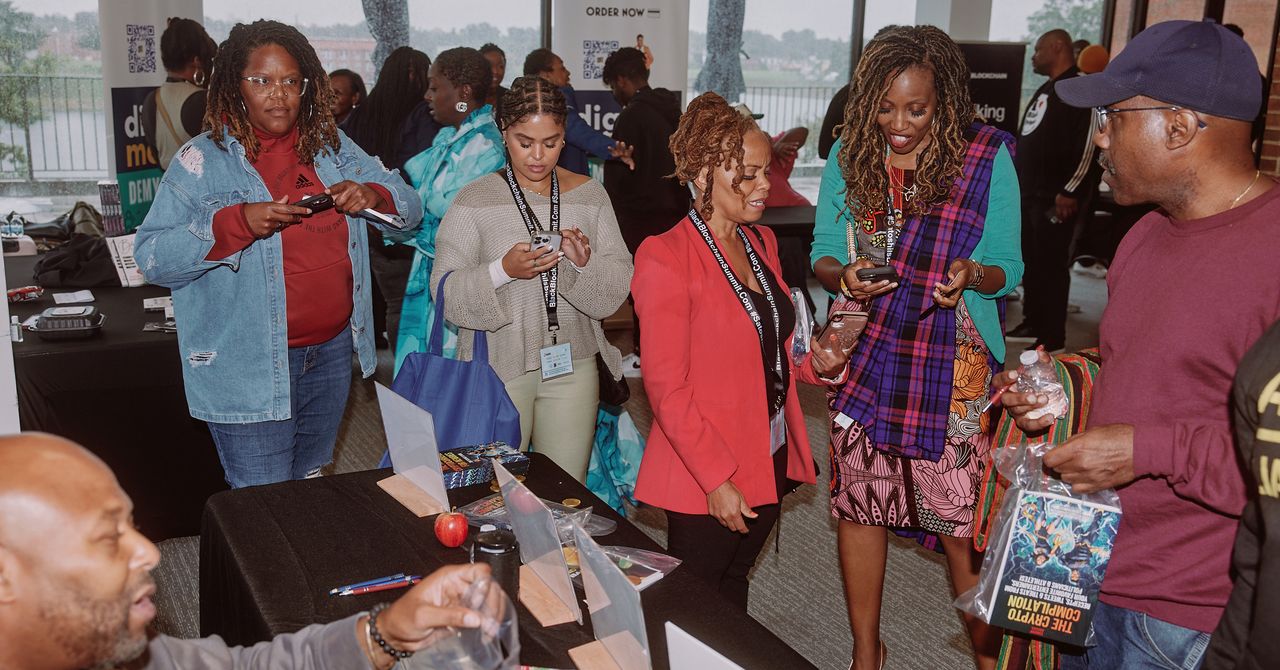
From November 16, 2023
Crypto holds a certain appeal for Black people. Black Americans are significantly more likely to invest in cryptocurrency than white Americans and to buy crypto as their first investment. A definitive picture of the current moment is hard to capture, but last year an estimated 25 percent of Black Americans owned cryptocurrency; for those under 40 years old the portion jumped to 38 percent. At the same time, Black people are significantly less likely than white people to think of cryptocurrencies as risky. They are about twice as likely to believe, falsely, that cryptocurrency is both safe and regulated by the government—a perception helped by Black celebrities paid to lend cultural cred to white-led crypto companies.
All this might start to form a picture of a Black populace that is uniquely vulnerable to crypto’s deceptions. But the Black Blockchain Summit insists on troubling this assumption. As the debris settles from last year’s crash, the energy in this room continues to be bullish. I want to know: What’s left to buy into?

Stevie Wonder: Songs in the Key of Life
We’re celebrating the 50-year anniversary of this paradigm-shifting work of art by playing this album on repeat, adding into the rotation the new EP of tracks from the album recording sessions, chosen by Stevie Wonder himself to release from the vault. See also: musicians reflecting on the album’s impact, a 2016 deep dive into the album’s recording, and Pitchfork’s perfect-10 review (also from 2016).


UPDATE: If you haven’t already, make sure to follow The Revival Lab on our social media accounts — we’re on Bluesky, Instagram, and YouTube!
- Wed., October 7, 2026: The People's Rally Against the BroBots (virtual)
Host: MediaJustice and Black Voters Matter
Join MediaJustice, Black Voters Matter, and the local organizers taking on Big Tech and hear directly from the folks leading fights to stop AI data centers and the growing stalker state.
- Thu., October 22, 2026: Research Tools for Organizers, Part 2: The Corporation (virtual)
Host: LittleSis
This training will demonstrate how to use the Securities and Exchange Commission’s EDGAR database to find strategic information in public filings from corporations and how to use that information in corporate campaigns. See other upcoming LittleSis trainings here.

 The Revival Lab
 The Revival Lab
 The Revival Lab
Thank you for reading!