
Election Day at the Conspiracy Slot Machine
By Madelyn Webb
[Disclaimer: Citations are available for examples of claims described in this issue, but have purposefully not been included in text to avoid amplification and algorithmic boosting of potentially harmful content. Please reach out to info@therevivallab.org for more info if needed.]
Late Tuesday night on November 3rd, the messages started rolling in. “Dude we won Georgia???? Might win SC????” And then came the memes. I, along with seemingly everyone else I know whose living relies at least in part on being immersed in digital spaces, had a great time online that night. For a few brief shining moments, the app formerly known as Twitter, often such an adversary to researchers, felt like a space for comedic minds to celebrate what many saw as a rebuke of conservative authoritarianism.
I relished the rare opportunity to revel in the humor and levity rolling across my feeds. As a digital extremism researcher, my daily experience online is generally unpleasant. I’ve monitored election misinformation narratives for four major election cycles, beginning in 2020. Since then, I’ve watched digital accounts spreading election fraud conspiracy theories and advocating for oppressive voting regulations grow in influence and impact. The broadest version of the corresponding theory is that the 2020 election was intentionally stolen from President Trump via a series of Democrat-led tactics like ballot harvesting, fabricated voting numbers, insecure voting machines, and a number of other sub-theories. Influencers have continued to spread these ideas across more tailored online spaces like Telegram and TruthSocial, as well as on more mainstream platforms like X/Twitter and Facebook.
These narratives have proliferated even when Republicans have won major races. I spent the morning after the 2024 election weeding through posts declaring a “new dawn” for America, one that far-right influencers promised would bring about mass deportations and the end of birthright citizenship. And with the rest of the country and the world, I’ve spent the years since then watching the government try to deliver on those threats.
Your generosity fuels our newsletter and research, strengthening the movement for media, tech, and information justice.
Donate now and join the revival today!
I’m aware of the limitations of electoral politics, but I’ll admit that election night this year felt exciting. It was interesting to see the spaces that I monitor assume a more defensive position. Instead of running victory laps about the coming horrors of their chosen administration, right-wing pages and influencers spent the hours following Election Day alternating between expressing despair at the perceived failure to fully execute on their priorities, insinuating that high voter registration and turnout rates signified fraud, and claiming a moral high ground in conservatives’ supposed decorum in the face of electoral losses. (Comments on such posts that mentioned January 6th went unacknowledged.)
Despite some significant differences in findings and results, I spent Election Day 2026 doing the same tasks that had filled Election Days in 2024, 2022, and 2020. In fact, both this year and in 2020, Election Day coincided with my birthday. My gift, once again, was scrolling through social media monitoring tools replete with posts from former Fox News hosts, Christian nationalist church founders, and failed-actors-turned-conservative-media-influencers, among other archetypes. Just as in years past, I had carefully curated filters and keywords in the preceding months designed to surface conspiratorial content targeting the voting process.
This work, though it might peak on Election Day, is ongoing. This type of monitoring is like a bitter, bottomless slot machine of content, grounded only by attention to power — understanding accounts or pages more holistically as political actors, tracking the actual reach of particular narratives, and investigating who funds it all. Sometimes, it’s helpful to see the posts, accounts, groups, and media as part of one big movement; at other points, it is absolutely necessary to disaggregate them. My aim is to trudge through it all and surface what actually merits the attention of organizers and advocacy groups fighting voter suppression and racialized intimidation. Instead of getting lost in the seemingly endless production of content, I must assign meaning.
That said, I don’t really do a lot of fact-checking. For the most part, the content I’m monitoring doesn’t contain any “facts” to check. Instead, I’m looking for narrative building — how certain claims and posts establish the groundwork for specific ideas to feel inevitable. Some posts feature sweeping claims about massive numbers of non-citizens voting, screenshots of numbers and statistics regarding jury subpoenas, a real photograph with a slightly misleading caption, or inflammatory rhetorical questions. Whether they contain any kernels of truth isn’t as relevant as what they’re trying to make politically possible. It's all about pattern recognition — understanding the vernacular and narrative tactics used by digital users and pages trying to achieve particular goals.
As a kid, I used to love “minute mysteries,” the ones that always included a key detail in the first paragraph. For example, a suspect might claim they were having a cigarette at the time of the crime, but readers might remember that in the first paragraph, the detective had hit his head on a “No Smoking” sign. Election fraud proponents tip their hand in much the same way. Why, this election cycle, did they obsessively direct attention to the specifics of voucher voting, or anything remotely concerned with Michigan, or “foreign contributions?” Turn the page upside down to see the solution. You guessed it — to integrate Islamophobic fear-mongering into their claims about voting infrastructure and procedure.
Unlike in previous years, I didn’t document too much active recruitment in the election conspiracy space. Whereas these pages had previously put out regular calls for ballot box monitors and pollwatchers, this year there seemed to be fewer calls for citizen participation. Perhaps Trump’s position in the White House and his constant reiteration that the 2020 election was fraudulent lessened the urgency for conspiracy brokers to pursue grassroots recruiting. Or maybe they got complacent.
Beyond more general calls to report “anything suspicious,” there were attempts to amplify one-off instances as evidence of widespread voter fraud. Westchester County’s failure to update their voting machine software led to some glitches that were almost gleefully circulated to stoke doubts. Yet another claim that a San Diego ballot box was emptied into an “unmarked van” (a type of observation usually weaponized to delegitimize mail-in ballots) had me rolling my eyes. Does your town have special branded vehicles for the County Registrar’s office? But these claims didn’t rack up the same engagement metrics, and other researchers and I didn’t see as much evidence of people actually turning up at the polls.
While there were fewer circulating calls to action — pushes for people to volunteer at polling places or run for county clerk positions — than in years past, a small but dedicated cadre of self-proclaimed “citizen journalists” still made it their mission to target random polling places across the country with surveillance tactics designed to intimidate. These influencers travelled to precincts around the country and harassed election workers. I watched so much footage of poll workers, in many cases unknowingly, filmed by people trying to incriminate them.
This isn’t a new tactic, but this more recent class of self-identified “citizen journalists” seems to be coalescing into a new monster. They do not show signs of slowing down, and they serve a critical role in right-wing media and information distribution. They exploit real but mundane issues with the American voting system to sow distrust in the larger process, and make the argument that not only is the system corrupted, but that it is intentionally so. And poll workers — whether or not they have been adequately trained — are not always prepared to seem competent and unruffled in front of a camera. In these videos, the election workers become a proxy for the larger system, and sometimes face personal consequences for their participation in what election conspiracy theorists argue is a fraudulent system. Through no fault of their own, and sometimes without their knowledge, poll workers may end up on the internet as the faces of election manipulation. These “citizen journalists” claim to be independent creators free from institutional connections, but November 12th will see the second annual Citizen Journalist Gala, hosted at Mar-a-Lago.
Beyond this type of targeting, I had reason to be concerned about Muslim voters, or anyone racialized as Muslim, facing intimidation and surveillance at the polls. This year election denialists dedicated significant resources to spreading anti-Arab hate, and Islamophobia more specifically. While my observation of white nationalist spaces has shown me a spectrum of digitally facilitated hatred, I was still profoundly disturbed at the sheer volume of virulent Islamophobia that pervaded these platforms. It appeared to be a central organizing tenet of those pushing election fraud conspiracies.
These spaces celebrated the persecution, belittling, and vilification of high-profile Muslim elected officials and candidates for office, including Representative Ilhan Omar and Senator-Elect Abdul El-Sayed. But the attacks on Muslims and Arab-Americans were not limited to those in the limelight. Right-wing influencers continued to insist that the presence of Muslims in America, and specifically at the voting booth, was a threat to American values and should be condemned in the strongest terms. They have sought specifically to weave this narrative into their arguments emphasizing the insecurity of American elections, similarly to how they have continued to target Latino voters and anyone they seek to racialize as “foreign.” According to them, American elections are allegedly insecure because Muslims are voting, and the more these insecure elections are allowed to flourish, the more Muslims will be voting and the more likely it is that “Muslim values” will be coming for everything you (white voters) have.
The morning after the election, racist rhetoric continued to circulate in right-wing digital spaces. Claims that the political power of white voters is directly threatened by the presence of Muslim Americans garnered huge engagement online. So while it felt like election deniers weren’t celebrating election outcomes, these influencers obviously did not wake up the day after the election regretful or deterred.
In tracking the impact of election conspiracy theories and their corresponding campaigns of racialized targeting and intimidation, success is difficult to measure. Election fraud narratives are only as relevant as the material gains they achieve. I have watched these movements and influencers succeed in their aims, and I am constantly aware of and concerned about their impact.
In the context of the long-term political goals of this movement, election deniers could count some gains. Four states passed laws adding voter identification requirements making it more difficult for people to vote. Additionally, four states voted to amend their constitutions and one passed a statute to specify that only U.S. citizens can vote — a condition already required by law for all federal and statewide elections but designed to create the illusion of a widespread issue and prevent municipalities from allowing non-citizen residents to vote in local elections.
But if the goal of these tactics is to disenfranchise voters across America, then the voter turnout on Election Day certainly foiled their plans. People contending with the anti-Black legacies of Jim Crow, gerrymandered districts, inconvenient polling locations, voter roll purges, and a host of other challenges showed up and won improbable victories. Narrative tracking can help understand how the case for these types of policies is made at the national and local scale, but the fights to protect the right to vote, encourage people to participate, and build political power have never been limited to the digital battlefield. The research that I do is intended to be just one tool to leverage in service of those goals.
For more information on narratives about the 2026 election, check out this report by the Media Democracy Fund’s Disinfo Defense League: Election Fraud Narratives in the 2026 Midterms.
###
Madelyn Webb is an investigative researcher tracking digital extremism.

- What the Media is Missing About Democrats’ Midterm Victories — More Perfect Union, November 6, 2026 (video)
In the wake of last week’s midterm elections, More Perfect Union offers a policy path for what needs to happen in order for the outcome to be the start of a permanent political realignment rather than a reaction to the corruption of the Trump administration. (More Perfect Union is a nonprofit media outlet dedicated to building power for working people. Support them here.) … Recommended by David
- Data Centers Were on the Ballot Across the US, and They Lost. What Comes Next? — Jenna Ruddock, Tech Policy Press/Free Press, November 5, 2026
Data centers lost almost everywhere they were on the ballot, and many of this month’s winning candidates made data center opposition a key component of their campaign. This article breaks down what happened on election night and what it means for the future of data centers and the communities rising against them. (Support Tech Policy Press AND support Free Press) … Recommended by David
- Hollywood Quietly Banning Prediction Market Betting on Movie News, Release Dates — James Hibberd, Hollywood Reporter, November 5, 2026
This article shares how Hollywood studios and production companies have been issuing new guidelines about prediction market betting among employees, addressing what some consider to be a gap in both understanding and regulation of the industry. … Recommended by Eesha
- The Private Equity Lobbyist Network Surrounding Chuck Schumer — Donald Shaw, Sludge, November 6, 2026
Democrats have retaken legislative majorities in both houses after an election in which the influence of private equity has come under considerable scrutiny. As people discuss possible choices for party leadership, this article shares context on Senator Chuck Schumer’s history and staffer relationships to the industry. (Sludge is a nonprofit project that reports on moneyed interests in politics. Subscribe to Sludge here.) … Recommended by Eesha

Selected by Eesha
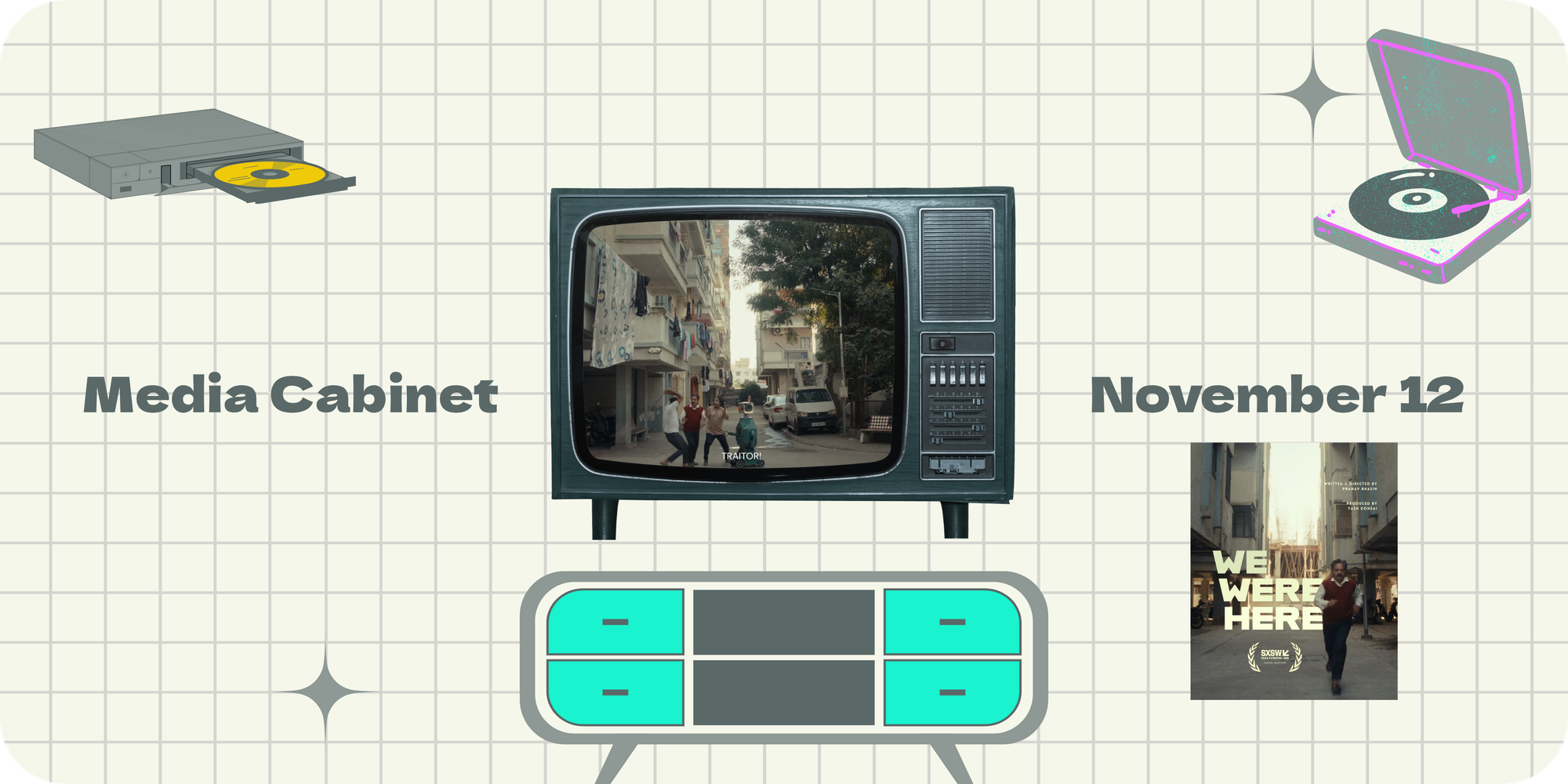
The Indian short film We Were Here, available online through The New Yorker’s Screening Room series, pushes back at the purported inevitability of AI, or “robots,” taking over jobs and social roles. Pranav Bhasin’s mockumentary portrays how three retirees decide to fight back — to the point of replacing the machines — and how their families react to their aims. It’s charming and funny and a little over ten minutes! Check it out!

From Madelyn Webb:
I reread Black Skinhead this year, and wanted to share a few passages. A theme in Brandi’s work that resonated with me is the power of understanding a narrative from start to finish — where it came from and what “hard truths” contribute to the building of cultural consensus — as well as the importance of using that knowledge to imagine more visionary futures.
Pg. 193: “People have a way of softening history. There’s a reason why history is written by the victors and those in power. To preserve an ideal of who we are and where we come from, stories get rewritten and hard truths get buried and finessed so we never have to confront our trail of inhumanity.”
Pg. 202: “This is the thing about how our narratives are often taken from us and reinterpreted. We are stripped of our voices even when telling the stories of our own lives, families and histories.”
Pg. 220: “The question to me is this: What would it look like to truly manifest an intergenerational, interclass movement committed to the unresolved economic and political issues that lie before us?”

UPDATE: If you haven’t already, make sure to follow The Revival Lab on our social media accounts — we’re on Bluesky, Instagram, and YouTube!
- Thu., November 19, 2026: Research Tools for Organizers, Part 3: Nonprofits (virtual)
Host: LittleSis
This training will discuss the role of nonprofits in elite power structures and where to find public information about nonprofit revenues, boards and staff, major contractors, grantees, and more. See other upcoming LittleSis trainings here.
- Fri., December 4, 2026: 5 Years of DAIR: A Livestreamed Celebration! (virtual)
Host: Distributed AI Research Institute
DAIR is celebrating its five-year anniversary with special guests, an interactive workshop, a new episode of their podcast, and more!

 The Revival Lab
 The Revival Lab
 The Revival Lab
Thank you for reading!