
Playing for the Big Leagues
A conversation with Yotam Marom
By David Dexter
Earlier this summer, I went to Yotam Marom’s book event in Washington, D.C. It was shortly after Janeese Lewis George — a democratic socialist — had won the Democratic nomination for mayor. There was a buzz in the bookstore. It felt like something had finally shifted within a city that had been occupied by federal troops for nearly a year.
For Louder Days: Reaching Beyond a Politics of Powerlessness (out now from The New Press) is a necessary, urgent exploration of the uncomfortable relationship the American left has with power. Yotam is a veteran organizer who once played a leadership role in Occupy Wall Street and has helped strategize for mass movements on the left ever since. The book is a practical, personal reflection on the promise and pitfalls of the past two decades of movement organizing, as well as what it means to actually have power and wield it.
As I watched him field questions from the audience in D.C., I thought about how quickly times change. Given the nature of the publishing industry, Yotam most likely started writing this book a couple of years ago at what seemed like a nadir for the American left. The far-right had swept into power again in late 2024 and progressive policy goals on climate change, health care, policing, antitrust, and more seemed further away. Many of those goals still seem far away now that Yotam’s book is out in the world. But there is also a popular democratic socialist mayor in New York and a good chance there will be one in the District.
This book is even more relevant in a time of an ascendant left. I was thrilled when Yotam agreed to speak with us for this newsletter. Yotam often shared spaces with The Revival Lab’s founder, Brandi Collins-Dexter, who built her career on studying the nature of power to more effectively contest it. She would have appreciated this book.
I hope that you enjoy our conversation below and that you check out his book.
Your generosity fuels our newsletter and research, strengthening the movement for media, tech, and information justice.
Donate now and join the revival today!
This interview has been edited for length and clarity.
DD: One thing that resonated with me about your book was its focus on what it means to truly be together in a movement. You have talked about how the left faces a challenge in that there are lots of different interests. It does seem that the information environments that we have to work with — algorithmic social media, increasingly conglomerated corporate media, etc. — are designed to atomize us. How can we build a better understanding of power and how to wield it within that information environment?
YM: I wonder if the answer is in part of the question. The point of resonance for you was the "together" part of it. What these tools tend to do is isolate us, and the way we overcome them is together. You can use the tools to be together. That is one of [their] functions.
I think we can use some of these tools to be more together but I do think that often the way we break hard movement dynamics — despair, whatever we need to get over — is by leaving the house and seeing each other and being together in action. So maybe that’s the answer to that.
DD: It did seem like there was a time during early social media when it was empowering organizing. Your background was in Occupy. What organizing principles did you rely on then, and have you seen them evolve? It’s been 15 years now, which is kind of wild.
YM: Occupy was part of the early distributed movements that social media helped spread. There’s the wave of Tahrir Square, and organizing in Spain, and if I’m not mistaken, Facebook was probably the biggest driver [of those].
I remember I had a flip phone at the time, and someone who worked at a union bought me an iPhone. They said, “We can’t wait for you to get home in the middle of the night to email us back. You need to have a fucking phone.” It wasn’t about social media, it was about rapid communication.
That time, as I remember it, was about being in person with people. Obviously, that has its own limitations. The social media explosion is pretty significant. It has made it possible for people to see in real time what is happening in the world, see how people are taking action, and find ways to join that.
But now, it is interesting to see people starting to return to some of the older practices. You’re seeing people say more often, “We’re only going to have this conversation in person or a little bit on Signal. We aren’t going to have these conversations online anymore.”
The fact that you can see everything that’s happening in the world all the time is not just an asset. It’s also debilitating. There is something important in being able to watch a genocide happen in real time and not be able to escape that or hide it or pretend it doesn’t exist. But it also fucks you up to watch that all day and not feel like you can do something about it.
DD: Do you think that is in some way by design now?
YM: Maybe, yeah. The onslaught of information for sure is by design. People analyze the way the Epstein Files come out as a way of assaulting us with too much unorganized information that we can’t make sense of. We can’t make meaning from it. We can’t parse what’s important and what’s not. We’re just overwhelmed by it and can’t really do anything with it. I would imagine lots of people feel overwhelmed with what is happening in the world and don’t know what to do about it, especially when our movements try to do something about it and can’t really succeed. That’s a heartbreaking experience.
DD: How necessary is collective failure as part of the pathway to power? Culturally, failure is not really seen as something you can come back from. How have you been able to navigate failure in your work and seen others do so as well? Is failure a necessary stepping stone to power?
YM: In a way, almost everything I’ve ever done has failed because we still live in this fucked system. But I think the task is to fail upward or gather lessons and do it better the next time.
Bloombergville was this two-week street occupation that I helped lead in the summer just before Occupy Wall Street. It was a street occupation to try to stop [Mayor Michael] Bloomberg’s budget cuts in New York City. It was a pretty abject failure. We did not stop the cuts, and it did not feel like a mass movement most of the time. It felt pretty fringe. And we all got arrested at the end and then it ended.
But some of that became Occupy. And Occupy also failed. At the end of the day, we had our occupations ransacked by the cops, and spent some months trying to come back and couldn’t. We definitely did not end capitalism. But here we are 15 years later with a socialist mayor of New York City and a bunch of socialists in office. There’s an actual left-populist movement with a base and dozens of organizations that were shaped by that time and hundreds — if not thousands — of leaders who were trained up in that time.
It’s an interesting thing, what you ask about failure being necessary on the path to power, because I think that’s true and, also, it’s only true if we can make meaning of the failure and see it as part of a broader story. When we don’t do that, it becomes this thing that in the book I call the politics of powerlessness, which is this settling into failure and expecting it. It’s even, in some ways, wanting it because it is comfortable and it is known and it is not as scary or threatening [as winning].
If we’re failing and we're on the margins, then we won’t have to do a lot of the hard stuff that we have to do if we want power. If we really want power, then we have to open ourselves up to people who are different from us. We have to create movement structures that can absorb millions of people. We have to be able to be in healthy conflict with each other to generate good strategy. We have to have these hard conversations internally about leadership and power and identity and all this stuff. If we don’t think we’re going to win, we’ll just accept being on the margins, and surround ourselves with people who are like us, and build boundaries between the movement and the public. [In that case, we] can afford to prioritize the feelings of the people in the space rather than the mission.
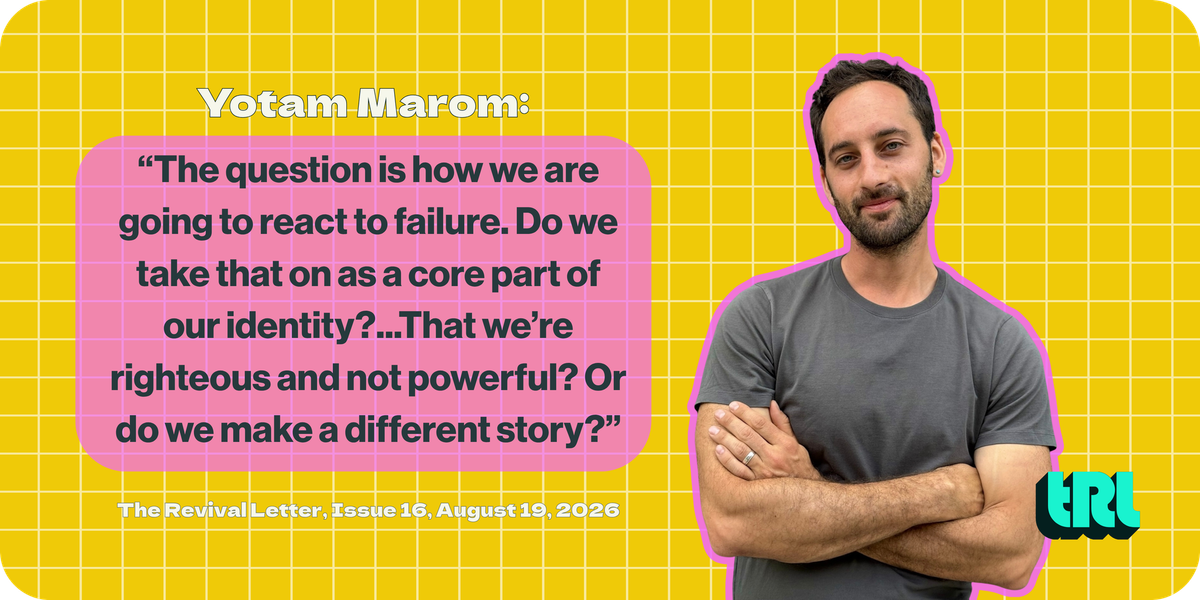
It is inevitable that we are going to fail a lot. The question is how we are going to react to failure. Do we take that on as a core part of our identity? That we are ultimately the underdogs, so what is important is that we’re righteous and not powerful? Or do we make a different story about our failures and how those failures are a necessary part of movement growth? Failure comes any time you take risks and experiment with things. We can fail in some ways and succeed in others by bringing people into the movement and by training ourselves. [That way], we’re inching closer to the world we want.
DD: One thing that comes with failure is grief. Grieving the world you want to see. Grieving your friends in the movement. Everybody processes these things on their own. We are probably around the same age. I cut my teeth as a college kid in the Iraq War protests. And obviously we didn’t stop the Iraq War. And that one did feel like a mass movement because you’re out here with thousands of people and you feel like you’re part of something huge and then they just kind of shrug it off and do the war anyway.
We’ve been through so much in the last two/three decades — where would you put yourself now on the hopefulness scale compared to previous iterations of yourself? When you were in Bloombergville, you were younger, not a parent yet, different in all these ways. How does that compare to the grizzled veteran you are today?
YM: I actually think I’m more hopeful now than I have been during most of my adult life. I do think that I had some pretty typical young person “we can change the world” energy, and some of that is rebellious personality stuff and some of it is what you described about the antiwar movement. It was enormous, it was historical at that moment, like, record-breaking large protests around the world. [It was] this feeling of, “Wow, all these people in the streets, we’re going to stop this war!”
My first movement heartbreak was not stopping the war. I think I went through a version of what a lot of people in the movement go through, which is this heartbreak that teaches us that not that much is possible. We won’t usually say that out loud, especially as young people. I really believed that a revolution was possible. But my behavior was that of someone who did not really believe that we were talking to a big public or would ever have to. That we would always basically be on the margins.
Occupy was another big puncture to that. That was my first experience of seeing, “Oh, we could be powerful. Look at all this. Look at all these hundreds of thousands of people and all these articles.” Every day felt like a week, and all these big transformations were happening. And then another heartbreak when that ended. But that wasn’t the same kind of heartbreak. From there, I learned some real lessons about the politics of powerlessness.
I feel — I don't know if I'd use the word hopeful — but I guess it is hopeful. I feel really moved and inspired by what is happening right now. But I have a more dulled perspective on that, which is to say we are going to experience a lot of loss. That is definite. There is no scenario, not even the best-case scenario, in which we don’t experience a lot of loss. Climate change alone is already putting enormous losses on us. People are experiencing the real effects of climate change all around us all the time, and that is going to increase no matter what the fuck we do.
Yet it is entirely possible we can change this country in a big dramatic way. But it isn’t going to happen through one election, and it isn't going to happen in the next couple years. If it does happen, it will have to go through millions of people who think extremely differently from us and some thousands of them who are armed. There is no way that that is going to happen quietly or easily or peacefully or quickly. I hope we can maintain a good amount of nonviolent discipline in the face of that, but that’s just the reality of what lies ahead of us.
That’s not despair; that’s just an understanding of the world we live in. There are paths for us and we are seeing some of that now. I’m really heartened by the fact that movements are beginning to confront this paralysis around power head-on, and that there are organizations and people around us who are saying, “We do want to be in power. We are playing for the big leagues. We are swinging for the fences. We want this. We deserve it. We can have it if we fight for it.”
I believe that.
###
David Dexter is the Project Director at the Revival Lab.
Additional links from TRL staff:
- How to Build a Real Strategy for Power — Yotam Marom, Convergence Magazine, July 7, 2026
This adapted excerpt from For Louder Days: Reaching Beyond a Politics of Powerlessness focuses on what it means to actually win power, and why it is necessary to embrace tension and conflict — instead of running from it — in order to get there. - Why Bravery and Heartbreak are Essential to Organizing — Hannah Sassaman, Waging Nonviolence, August 11, 2026
This review of For Louder Days, written by friend-of-the-newsletter Hannah, combines her personal experiences with her reflections on how deeply Yotam’s book has helped shape her understanding of power even after decades on the front lines. - Reaching for Our Power: Q&A with Yotam Marom — Eleanor J. Bader, Political Research Associates, August 11, 2026
This conversation digs deeper into the book’s discussion of leadership development, organizational health, and strategy, alongside some of the other themes from the interview above. - “A City We Can Win” Rally Speech — Zohran Mamdani, June 14, 2025
At the 30:10 mark in this video from a rally shortly before the New York City mayoral primary election in 2025, Mamdani spoke of how the left needed to win real political goals and victories, not just reflect poignantly on falling short. As he put it, “the days of moral victories are over.” His outlining of political stakes in this speech presents an interesting complement to this issue’s interview and its reflections on movement failures.

- What the Flock? Exposing Big Tech’s Surveillance State — Timothy Karr, Pressing Issues, August 18, 2026
A mass movement is forming against the growing corporate/AI-driven surveillance state. See how people are mobilizing across the country to resist Flock and others that are part of this burgeoning multibillion-dollar industry. (Pressing Issues is the newsletter for media advocacy group Free Press. Donate to Free Press.) … Recommended by David.
- How AI is Reshaping Election Information Ahead of the 2026 Midterms (podcast & transcript) — Justin Hendrix, Tech Policy Press, August 16, 2026
Hendrix interviews Lawrence Norden from the Brennan Center on the organization’s recent expert brief regarding AI and electoral disinformation. We found the most useful parts of this discussion to be the specific issues across chatbots and amplification platforms contextualized with broader concerns about information consumption and election infrastructure. (Tech Policy Press is a nonprofit media and community venture covering technology and democracy. Donate to Tech Policy Press.) … Recommended by Eesha.
- The Orwellian Company Behind ICE's New Electric Shock Gloves — Sophie Hurwitz, Mother Jones, August 15, 2026
This article dives into the dystopian sales pitch and evolving marketing materials of Compliant Technologies, which will be delivering 20 million dollars’ worth of “electric shock gloves” to ICE and DHS in 2027. Among other findings, there are quotes from law enforcement officers praising the gloves for allowing them to inflict pain without leaving easy evidence for potential lawsuits. (Mother Jones is a nonprofit, independent, reader-supported newsroom working to deliver reporting that raises awareness and inspires change. Subscribe to Mother Jones.) … Recommended by Eesha.
- What Was the Internet? — Siva Vaidhyanathan, Avery Dame-Griff, Joanna Walsh, Chad Wellmon, Cory Doctorow, Matt Lord, Boston Review, August 6, 2026
As the internet experience rapidly deteriorates at the hands of massive tech companies and their push for AI, several writers share their thoughts on what being online used to be like, and what the future may hold. (Boston Review is a nonprofit web and print magazine of ideas, politics, and culture. Subscribe to Boston Review) … Recommended by David.
- How We Found Amazon is Destroying Rare Books to Train AI — Emanuel Maiberg, 404 Media, August 17-19, 2026
This video expands upon an investigation that dropped earlier this week, which followed up on the concerns of a seller of rare books and discovered that Amazon has been purchasing large quantities of books, sending them to a facility, scanning them to train AI models, and then destroying them. The reporter explains the methods, findings, and implications in this video. Paid members can find the original article here. (404 Media provides independent, impact-focused tech journalism. Subscribe to 404 Media.) … Recommended by Eesha.

Hypermasculinity & The Stupidity of Homophobia
Antonio Speaks is a new creator whose video essays on politics and pop culture have taken off in the last year. Antonio fights against redpill ideology, particularly the intersection of antiblackness, misogyny, and homophobia so popular with young men online. This includes fearlessly taking on everything from white supremacy to gang culture. In this scathing critique of homophobic rappers and oversexualization in hip hop, Antonio lays out healthy visions of masculinity while simultaneously uplifting queer people. This isn't cookie-cutter PC ideology or academic jargon. Instead, Antonio Speaks is an example of a new, unfiltered progressive resiliency growing online, and a new genre of young male creators who are cutting through the toxic static of the manosphere.

Today’s media cabinet covers a few different movie genres, with characters (in several cases, real-life people) resisting apathy and fighting back against institutional harm. Check out our list and brief descriptions below!
- Erin Brockovich (2000): Spielberg’s critically and commercially beloved biographical drama features a transcendent Julia Roberts as the title character, fighting back against the corruption, neglect, and catastrophic health and environmental harm produced by privatized infrastructure companies. Now, in 2026, the real Erin Brockovich is mobilizing people to map the construction of AI data centers and highlight their disruptive social and environmental impacts on communities. (Rated R)
- Everybody to Kenmure Street (2026): Felipe Bustos Sierra directed this documentary about the 2021 protests in Glasgow, Scotland, where a community assembled to successfully prevent the completion of an immigration enforcement raid. The movie has been screening in different American cities all summer, and the jolt of energy and inspiration it provides is well worth the watch.
- Good Luck, Have Fun, Don’t Die (2025): Director Gore Verbinski’s latest film, a sci-fi comedy penned by Matthew Robinson, garnered mixed reviews for the story of a man from the future recruiting people from a recognizable — but slightly off — present day to fight an oppressive artificial intelligence that has essentially eradicated humanity in his time. But the dramatic, often violent choices of the movie coupled with its dark comedy clearly serve as a call to action for the audience. (Rated R)

UPDATE: If you haven’t already, make sure to follow The Revival Lab on our social media accounts — we’re on Bluesky, Instagram, and YouTube!
- Thu., August 20, 2026: LittleSis Training: Power Researching Elected Officials (virtual)
This training will show attendees how to power map an elected official and how to research their campaign donors, as well as provide examples of how organizers have used research on politicians to sharpen their strategy. See other upcoming LittleSis trainings here.
- Thu., August 27, 2026: The Nerd Reich MCF Book Club (virtual)
Host: Marguerite Casey Foundation
Gil Durán, author of the recently-released The Nerd Reich: Silicon Valley Fascism and the War on Democracy, will be in conversation with Prof. Safiya Umoja Noble from UCLA and Jacinta González from MediaJustice to discuss “the rise of technofacism, the antidemocratic aims of Big Tech, and how communities across the country are organizing (and winning!) against Big Tech’s authoritarian power.”
- Sat., September 19, 2026: Fighting TechnoFascism: Power, Surveillance, and Resistance (in-person: Chicago)
Hosts: MediaJustice and Mijente
A one-day convening of nationwide organizers fighting energy-sucking data centers, the surveillance state powered by Flock, and tech-enabled mass deportations and murders.

 The Revival Lab
 The Revival Lab
 The Revival Lab
Thank you for reading!